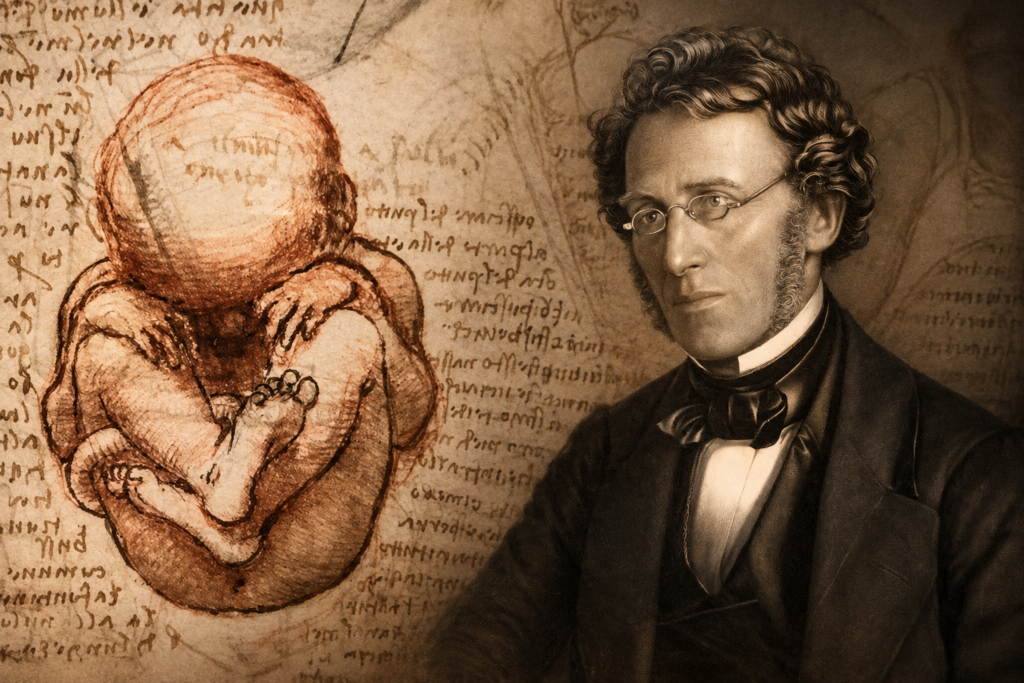
On Nov. 6, 1839, Dr. Hugh Hodge gave an introductory lecture at the University of Pennsylvania to a hall full of medical students. As they carried out the obstetrician’s task of caring for pregnant women, he told them, they would be caring for mothers, but “we should not forget her offspring, in the various stages of its existence, from the moment of its conception to delivery, from birth to the full development of its physical and moral nature.”
Hodge meticulously laid out the evidence that a pre-born child in the womb is an independent human being from his mother; noted that in the physiological sense, a child in the womb is as independent as an infant at the breast; he carefully rebutted those who argued that a child in the womb does not have a soul until sometime after conception. Reading the lecture almost 200 years later it sounds, but for some archaic language, almost precisely like many pro-life apologetics presentations I have attended.
Hodge’s lecture was one of the first significant condemnations of abortion in medical terms. Today, the narrative that abortion activists push is that the legalization of abortion in the 1960s and 1970s was a rejection of religious dogma and a return to a science-based approach to medicine. The opposite is true. In his groundbreaking lecture, Hodge rejected the philosophical and religious view that the fetus is essentially “inanimate” until some point during pregnancy—and asserted that because science tells us when life begins, we can definitively conclude that abortion is murder.
“It is in vain to evade this conclusion,” Hodge stated. “As far as human investigation has gone, or probably ever will go, in penetrating the mysterious function of generation—as far as the light of reason or the torch of revelation has elucidated the subject—there can be no reasonable doubt, that human existence, corporeally and spiritually, commences not with the birth of the foetus and the first inspiration, but at conception; when the germs furnished by both parents are quickened into life.”
I first learned of Hodge’s pro-life advocacy from Marvin Olasky and Leah Savas in their essential book The Story of Abortion in America: A Street Level History, 1652-2022. Hugh’s father—also Hugh, and also a doctor—served as a military surgeon in the Revolutionary War, set up a medical practice in Philadelphia, and married Mary Blanchard, an orphan from Boston. They had five children; three died of yellow fever in the epidemics that swept the city. The father also died of complications of yellow fever in 1798, several years after his children. Death came often to the Hodge home.
The two surviving sons were Hugh Lenox Hodge, the “pioneering pro-life physician,” and Charles Hodge, the “pro-creation theologian who wrote three volumes of systematic theology still read in seminaries today.” (Charles would marry Benjamin Franklin’s great-granddaughter, Sarah Bache, and become one of America’s premier theologians and one of Charles Darwin’s greatest adversaries.)