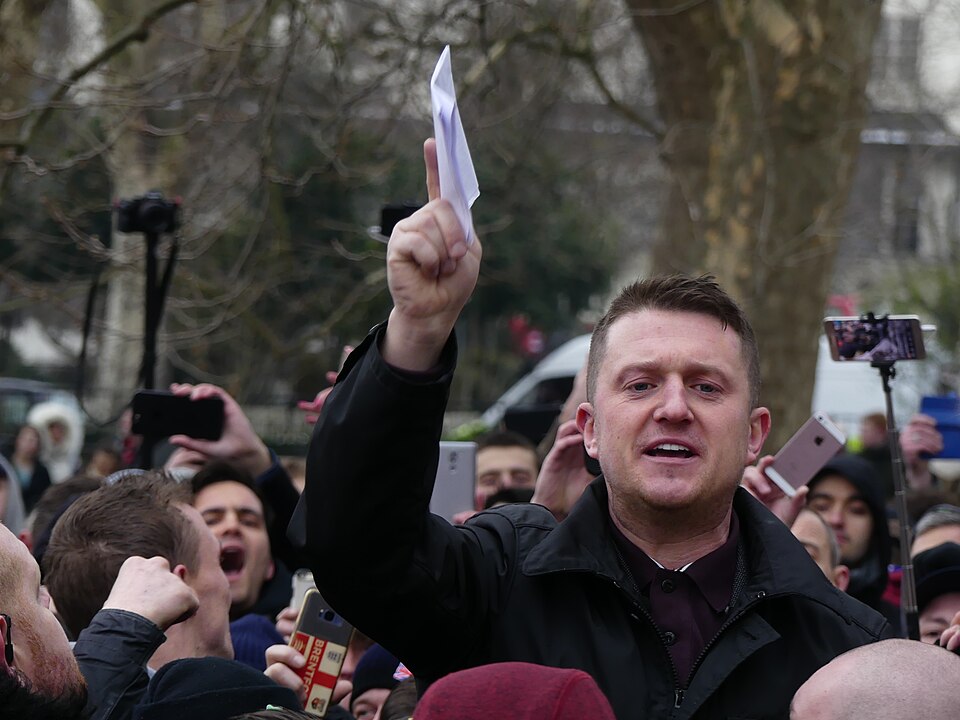
n a scathing column at Unherd last month, Anglican priest Giles Fraser took aim at one of the most controversial men in England: Stephen Yaxley-Lennon, better known as Tommy Robinson. Robinson, after a recent stint in prison from November 2024 to May 2025 for contempt of court, now identifies as Christian. This was Robinson’s fifth stint in jail, mostly for activities related to his anti-Islam activism, which has defined his public life since founding the English Defence League in 2009 (he left the group in 2013, stating that it had become too extreme).
Fraser’s missive was a scathing rebuke of “Christian nationalism.” Robinson’s recent rallies have been marked with chants of “Christ is King,” Christian symbolism, and even clergy appearances. When Robinson organized a high-profile “Unite the Kingdom” carol service in December, the Church of England condemned it, warning against the “capture of Christian language and symbols by populist forces.” Fraser bluntly called Robinson a “cynical Christian” and accused him of using the language of faith to push a political agenda.
It is not a frivolous critique. The language of Christianity is being weaponized by many political actors who find it useful even though they do not believe it or fundamentally misunderstand its message. Western civilization is inextricably intertwined with Christianity, and nationalist movements have found this Christian heritage a convenient arsenal of potent images and symbols. There are plenty of examples of “Christ is King!” being chanted for political purposes—which is, in theological terms, taking God’s name in vain.
But when I asked Robinson about this in a Zoom interview just prior to Christmas, he didn’t start with England, or Western civilization. He started with himself. “I think, for me personally, I’ve lived quite a sinful life,” he told me. “Even up until recently, I’ve lived a sinful life, and as I started talking about it with the pastor in jail and thinking about what makes you a good man—I was a bad husband.” He lowered his voice—he was at his ex-wife’s house.
“My struggle comes, I’ll be totally honest, Jonathon, I’ve lived a very sinful life,” he reiterated later in our conversation. “I’ve lived a sinful life with everything, and I’m not being a good man at times, morally speaking. That’s me speaking honesty. I’d love a brand-new fresh start, to live my life as a good man, which is to live life as a Christian. I’m a Christian. I believe in Jesus. But I’d love to be a better Christian.”
Robinson says as much about the early activist days of the English Defence League, which were marked by running street brawls with opposition groups, clashes with the police, and general hooliganism. “We were chaotic, pretty embarrassing at times, how we conducted our behavior,” he said. “I was young and I’d learned a lot about how to demonstrate, how to negotiate with police, what we could do to keep our demonstrations peaceful. But I’d also learned that identity and culture were the main driving forces of the English Defence League.”
The Church of England’s condemnation of his carol service is not his first run-in. “The Church is coming out strongly opposed to us having a Christmas carol service and a Christian service in London,” he told me. “They’re condemning us. This is something that’s happened since 2009, when we started the English Defence League. Really, we went out on the streets and we cried for help. We were trying to highlight the things that happened in our towns, especially the rape gangs, which were covered up and hidden.”
We were the lost sheep, as a movement. We were working class men. We’ve got no faith. We’ve got no church. We’ve lost our belief. And when we’d go into a city, the church leaders would line up with the Muslim leaders to actively condemn us. In every city we went to, the Church was against us. I felt disgust at the Church.
The Church simply had no idea what to do with England’s wild, frequently violent lost boys. Early on in those years, Robinson recalled, Bishop Tony Robinson reached out and asked if he’d attend a meeting with Islamic leaders of the Deobandi sect, which was held at a church in Darbyshire. The mullahs were brought in, and they talked about their diversity program at the church, which included a Christmas celebration with the Muslim community. Robinson asked if it included wine. It didn’t.
“I said: So you had a Sharia-compliant Christmas meal because the Muslims wouldn’t have accepted it.” For Robinson and his allies, this was about more than cultural sensitivity—it was about surrender. “This is the problem—that you are bending on every belief and everything that goes with our culture and identity. You bend. They don’t. They would never bend. You could go to one of their events, and they’re not going to change anything for you.”
For me, this is the problem with Christianity in this country, the problem with the leaders. You’re flying rainbow flags. You’re pushing agendas. The bloke in Luton who was always a representative of the diversity group and the church spokesman, he’s just a Marxist. I believe he’s infiltrated the church for his own political views. Because of that, I sort of despise the Church. I felt: You’re sellouts, the churches are empty, and there’s a reason they’re empty.
I used to go to church, and my mom was a Catholic, and I asked Deacon Jerry at the start of my activism. I explained to him: “I’m struggling in Luton, I’m struggling with Islam, I’m struggling the more I find out about the teachings of Islam. What’s your advice?”
He just said: “The Lord’s Prayer.” And he homed in on “Forgive us our trespasses, as we forgive those who trespass against us.” I said: “Forgive them? They’re raping their way through our town! Our daughters are being taken! Forgive them? That’s your advice to what we should do as Lutonians about what’s happening?”
Robinson felt betrayed by the condemnation of the clergy. “You have got nothing in common with us as working-class men and women,” he said. “You cannot speak our language. You do not even understand who we are. The mosque doesn’t have that detachment. It really doesn’t. Especially in the prison system now, I’ve been fascinated with Islam in prison and the way it controls areas, and I’ve seen the weakness of priests in prison. They surrender.”
“But when I went to Woodhill Prison, the pastor that comes to my cell was an Asian man from Glasgow who was in the military prior to becoming a pastor,” Robinson told me.
He lived a normal life. He lived a rogue life at times until he found God, and I really related with it, which helped me open my ears and want to learn. I’ve always wanted faith, but I’ve struggled with it. I’ve struggled with it. People talk about this Holy Spirit, and I’ve thought: I want that. I want to believe. I spent months in solitary confinement wishing I had faith.
But this time, I started going through Bible studies, which I’ve never done. Because I was in solitary confinement, they allowed me time with a priest every week. He would come and sit with me one-on-one, and we’d do Bible studies and talk about Christianity and talk about the church. He made me realize the Church that I despised was not the church that he’s a part of. He’s a part of the Free Church [a mid-19th century break-off from the Church of England with Reformed Protestant roots], and there’s many who are awake to the problems that this country faces.
Robinson needed pastors he could relate to and, perhaps more importantly, that could relate to him. He met one, in the early days, who simply asked him for a meeting.
The pastor had been a journalist for the Sunday Times before “he’d found God,” and he asked Robinson if he could pray for him. “It’s the first time anyone had sat and put their hand on me and prayed for me. He told me a story of being in Africa and being in a church and feeling the Holy Spirit come into him.” The pastor, who ended up becoming a military chaplain, kept in touch, and visited him when he ended up in prison.