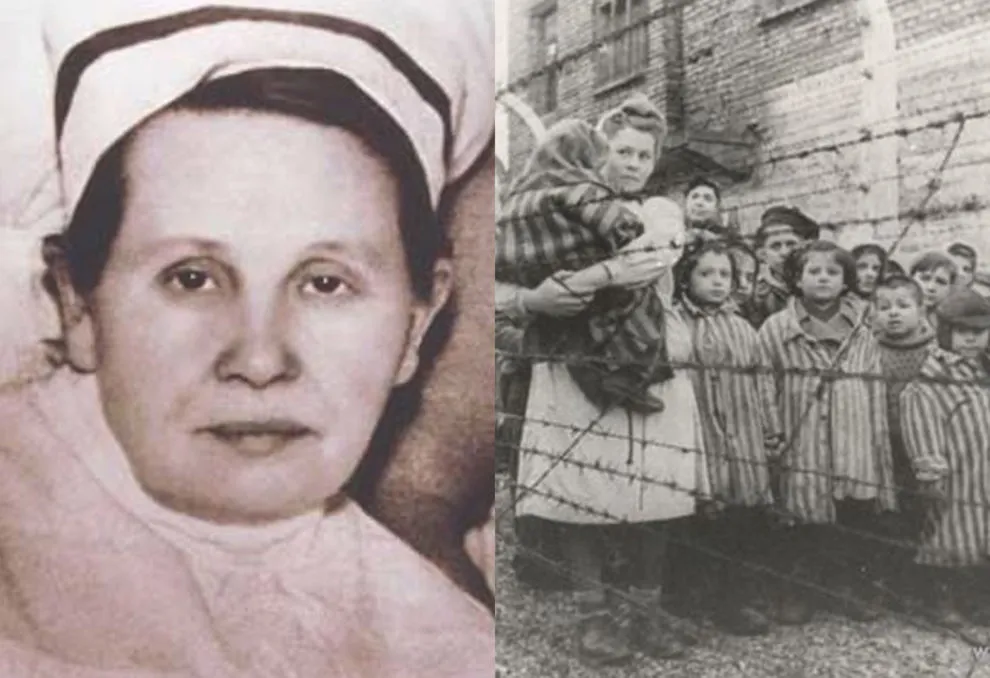
Auschwitz’s “Angel of Death,” Dr. Joseph Mengele, was furious with the small, stubborn Polish midwife standing before him and refusing his orders. He was accustomed to exercising the power of life and death simply by pointing left or right when the long trains discharged their human cargo. But Stanisława Leszczyńska, tasked with throwing Jewish babies directly into the garbage after delivering them, would not yield.
Both were medical professionals. One had risen to the peak of human power: a Holocaust survivor described encountering Mengele on the train ramps as an officer “dressed in splendor” in white gloves with shining, polished black riding boots, sending thousands to the gas chambers. The other was a captive, middle-aged woman who had no power—save one. She could refuse to do harm, on pain of death. It was all she could do, but for the babies she saved and the mothers she loved, it was everything.
***
Stanisława was born in Lodz in 1896 to a working-class family. She married Bronislaw Leszczyńska in 1916, and the following year gave birth to a premature son; his near-miraculous survival attracted Stanisława to midwifery. By 1920 when she headed off to midwifery school in Warsaw she had two children, and two more were born later. When Stanisława graduated, she went to church, got on her knees, and made a solemn prayer: If she ever lost a baby, she would give up midwifery.
“The family lived in a largely Jewish neighborhood and Stanisława and the children spoke Yiddish—a talent that would come in handy in Auschwitz when Stanisława found herself serving thousands of Jewish women of various nationalities,” notes Meg Hunter-Kilmer, who has written extensively about Stanisława . “[She] had many Jewish friends in addition to her Jewish patients; she even visited synagogues regularly to pray with the congregations and often invited rabbis to the family home for a meal and a spirited debate.”
On September 1, 1939, the Nazi blitzkrieg smashed into Poland. The Jews of Lodz were confined to a ghetto, and the Leszczyńska family were evicted from their home, which became part of the ghetto. The family soon became involved in smuggling food and false papers into the ghetto and Jews out of it. Stanisława, Bronislaw, and all four of their children were involved in this life-saving work, but in 1943, the Gestapo caught on. Bronislaw and their oldest son managed to flee. Stanisława and the younger children were captured.
Her remaining two sons were sent to Mauthausen-Gusen as slave laborers. Stanisława and her daughter, Sylwia, a medical student, were sent to Auschwitz, where they were tattooed with the numbers 41335 and 41336. After telling a Nazi doctor that she was a midwife, Stanisława was sent to the death camp’s “maternity ward,” which, more often than not, served as a holding pen for women on their way to the gas chambers.
To be pregnant at Auschwitz was usually a death sentence; one doctor, Gisella Perl, performed abortions on women to delay this. Two other midwives, “Sister Klara” (who was imprisoned for murdering a child) and “Sister Pfani” would declare newborn children “stillborn” and drown them in buckets, often in front of their mothers. Stanisława refused to participate, even when facing Mengele himself, clinging to her conviction that every baby was precious.
This refusal was likely what made Mengele decide to subject Stanisława to one of his infamous experiments. She was given an injection and fell ill with spotted typhoid fever. She struggled for several days but knew the danger of appearing ill and continued to make herself as useful as she could in the infirmary until she recovered. Mengele also experimented on her daughter, twice; Stanisława saved her Sylwia by threatening to accompany her to the gas chambers. Needing midwives, the Nazis relented.
Stanisława handed the babies to their mothers, knowing most would be murdered soon after, giving them at least a few moments together. She refused to let the inhumanity of the camp change her. Instead, she treated those mothers and their babies exactly the way she would have treated any noblewoman and her child, with dignity and love. She said that each child felt, in her arms, like the Christ child. She performed emergency baptisms on Christian babies. She sang hymns to mothers and babies. She prayed with all.