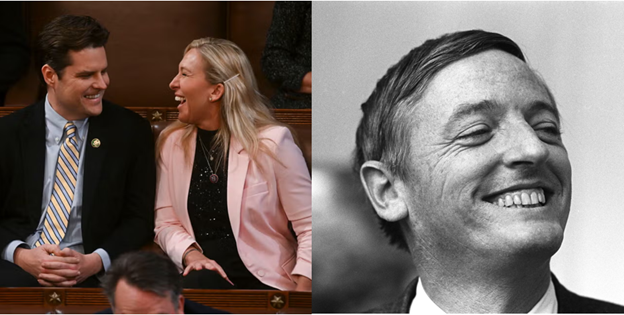
The late William F. Buckley, the founder of National Review, host of The Firing Line, and a conservative figure so ubiquitous that he had to space out his books so they wouldn’t compete with each other on the New York Times bestseller list, has been much maligned by the new “MAGA movement,” whatever that turns out to be. Reading his new biography by Sam Tannenhaus, Buckley: The Life and the Revolution That Changed America, I was struck time and again by how much we could learn from him.
“What did he want to conserve? Western civilization,” Jay Nordlinger wrote recently of Buckley. A quick scan of the X profile bios and AI-generated memery of MAGA edgelords and digital outrage farmers indicates that “fighting for Western civilization” would appear, on the surface, to be a popular pastime. But I can’t help noticing that many of the angry “culture warriors” fueling the national conversation do not even appear to have a culture—they have only war, waged endlessly on despair-riven digital battlefields.
To defend your culture, you must first have a culture. To defend Western civilization, you must, surely, know what that is.
Buckley knew what he was defending because he adored it. “Three hundred years ago on March 21,” WFB wrote, “Johann Sebastian Bach was born. The event is as though God had decided to clear His throat to remind the world of His existence.” The MAGA warriors, however, do not appear to have Bach; in fact, they appear as culturally illiterate as their revolutionary opponents. It is not that they could not have Bach, or any of the other great treasures of the Western cultural inheritance. It is that for them, “defending Western civilization” is not about love. It is about rage.
As G.K. Chesterton put it in a popular quote that is clearly not yet popular enough: “A real soldier does not fight because he has something that he hates in front of him. He fights because he has something that he loves behind his back.”
Much of this rage is understandable. As Machiavelli once noted, “a man is quicker to forget the death of his father than the loss of his patrimony.” Some of it is even righteous indignation at the cultural degeneracy that has become the new moral core of the West, from gender ideology to our bloody abortion clinics with their great clouds of souls rising through the roof. There is much to hate about what the West has become. But as Martin Amis observed, “hatred is a stimulant, but it shouldn’t become an intoxicant.”
One way to think about the difference is about whether your politics begins from what you care about most — what you love — or whether it begins from what you fear and what you hate. To me, as a young person, conservatism was appealing, and has remained appealing, because it’s fundamentally rooted and begins from what we love in the world. It is a defense of what I take to be best about the world.
What is best about the world is always threatened. It’s always challenged. It’s challenged just by the realities of human nature. Sustaining it requires work. It requires moral formation and political action. And that’s the work that conservatives at their best do — we conserve the preconditions for a flourishing life in a free society.
But if the reason you have for entering politics, first and foremost, is to combat the left, to oppose what you don’t like, then your politics are going to be different than that. Now, look, to defend what you love means fighting people who oppose it. And politics is argument, and it’s always contestation.
But I think it matters a lot whether fundamentally the reason that drew you in is itself the fight or whether the reason that drew you in is a commitment to something you love, is fundamentally conservative, is about wanting to preserve the good.
That is precisely it, I think. Many today might now despise William F. Buckley—because he gatekept the antisemites, kooks, and conspiracy-mongers; because he strikes them as a snob with highbrow tastes; because their own accomplishments feel mean and pathetic in contrast to his—but he was kind, generous, loyal to his wife. So was Ronald Reagan, the beneficiary of the movement Buckley built and the great president who defeated the Evil Empire. These men proved that you could wage ideological war without cruelty and win.
Interestingly, Buckley’s most famous TV moment came during his 1968 faceoff with Gore Vidal, in which he lost his temper, called Vidal a “queer,” and threatened to punch him in the face. An entire documentary was made about the exchange. Today, this would be the sort of clip that could make a mid-tier MAGA influencer famous, but Buckley was deeply ashamed that he’d lost his temper, and until the end of his life, even when praised for it, he would swiftly demur and change the subject. The moment was an aberration and a regret, and this says much about the man, and about us.
In fact, WFB’s novelist son Christopher told me that he would not watch the documentary out of loyalty to his father, who would have hated seeing what he saw as one of his worst moments become the centerpiece of a film.
William F. Buckley recognized that to defend Western civilization, you must also be civilized. This is not to say that would-be culture warriors must share Buckley’s taste in music or literature or art. But it is true that character is destiny; as Peggy Noonan memorably put it of Ronald Reagan, character is king. Those like Tucker Carlson—who trash Buckley while fawning over Marjorie Taylor Greene, Matt Gaetz, and Candace Owens—are telling us what kind of culture they wish to have, and who they believe should have influence in that culture.
Many of today’s “influencers” are not valiant culture warriors defending the West. They are case studies in just how far the West has fallen. Their rejection of Buckley is, quite possibly, the greatest posthumous compliment they could give him.