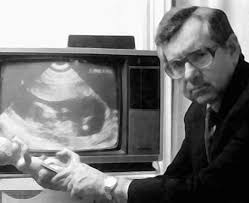
In 1984, Dr. Bernard Nathanson asked his colleague to film an abortion. He had seen the results countless times as the director of the largest standing abortion clinic in America. But abortion, he noted, “is a blind procedure”; after it was over, all that remained was “a little pile of meat in a gauze bag.” Nathanson was publicly grappling with his own views on abortion, and he had stopped doing them himself—but he had a friend who did about twenty a day.
“Next Saturday, when you’re doing all these abortions, put an ultrasound device on the mother and tape it for me,” Nathanson requested.
Nathanson was “shaken to the very roots of my soul by what I saw.” So was his friend, who never did another abortion. The footage was turned into a film called The Silent Scream, which was aired on national TV, screened in the Reagan White House, and viewed by millions. In the film, Nathanson describes a pre-born child desperately tries to escape the suction aspirator; at one point, “we see the child’s mouth wide open in a silent scream.”
“If every member of Congress could see that film, they would move quickly to end the tragedy of abortion,” President Ronald Reagan said the following year. Many, however, refused to accept the truth revealed by The Silent Scream: that abortion is an act of violence against the child in the womb. Dr. Bernard Nathanson was one of the extraordinary few who, upon encountering the truth, decided to defect from the abortion movement that he had helped to found and spend his life defending the pre-born.
***
The son of an obstetrician-gynecologist raised in New York City, Nathanson followed in his father’s footsteps, attending Cornell University and then McGill University Medical College. When his girlfriend became pregnant, he tracked down an abortionist. She was unharmed by the illegal procedure, but the experience persuaded him that the abortion laws needed to be changed. As an intern and resident, he found himself treating women who had attempted their own abortions.
With journalist Lawrence Lader, Nathanson founded the National Association for the Repeal of Abortion Laws (NARAL). They teamed up with Betty Friedan and other feminist leaders, engaged in “coalition building with the Woodstock nation,” and partnered with radicals such as Howard Moody, the pastor of the Judson Memorial Church in Manhattan’s Greenwich Village. “We would settle for nothing less than striking down all existing abortion statutes and substituting abortion on demand,” he wrote in his memoir.
In April 1970, abortion was legalized in New York, and Nathanson took over a Manhattan abortion clinic. Within six months he had turned it into a machine. “It had 10 operating rooms, 35 doctors, 85 nurses,” wrote Nathanson. “It operated seven days a week, from 8 a.m. to midnight. We did 120 abortions every day in that clinic. At the end of the two years that I was the director, we had done 60,000 abortions. I myself, with my own hands, have done 5,000 abortions. I have supervised another 10,000 that residents have done under my direction. So, I have 75,000 abortions in my lifetime.”
Two of those abortions were his own children.
***
Nathanson was personally and professionally embedded in the abortion movement, and he was the only major medical figure on NARAL’s board. He inspected abortion clinics to see if they qualified for NARAL membership (and was stunned by how many were filthy). He had revived New York’s largest abortion clinic; the “safety record of his clinic did much to establish the aura of respectability upon which the Supreme Court relied in its 1973 Roe v. Wade decision to legalize abortion nationwide,” as did his article on outpatient abortion in the prestigious New England Journal of Medicine.
By 1973, however, Nathanson was tired of the infighting in the abortion movement and left the clinic, though he still spoke publicly in favor of abortion rights. That same year, he took on the directorship of the obstetrics and gynecology department at New York’s Women’s Hospital. Nathanson brought in fetal electronic heart monitors and other equipment; his job changed dramatically from abortion to fetal health.
“[W]hat began to erode the NARAL dogmas was the daily realization of the ‘intrauterine patient’ that we were treating, tracing, sampling, and observing through electronic monitoring of the flickering images on an ultrasonic screen,” he wrote. He first resisted the philosophical implications of the evidence he was seeing. “When one is caught up in revolutionary fervor, one simply does not want to hear the other side and filters out evidence without realizing it,” he admitted. But in 1974, he published another essay in NEJM: “Deeper into Abortion.” He had begun to change his mind.
“There is no longer serious doubt in my mind that human life exists within the womb from the very onset of pregnancy, despite the fact that the nature of the intrauterine life has been the subject of considerable dispute in the past,” he wrote. He still believed that abortion should be legal, but he was now also concerned with “fetal rights.” It was the first step in one of the abortion movement’s most significant defections. Witnessing fetal life in the womb at the Women’s Hospital almost every day, Nathanson was simply too intellectually honest to look away.
Nathanson’s allies in the abortion movement promptly began to disassociate with him; on the other hand, as someone who was still officially “pro-choice,” he could not yet reconcile with the pro-life movement. Aligned with neither side, he continued working as a prominent physician while throwing himself into research and philosophical reflection. In 1979, he published a bombshell book: Aborting America: A Doctor’s Personal Report on the Agonizing Issue of Abortion. Nathanson had officially switched sides.
***
Nathanson’s defection was devastating for the abortion movement because he not only knew their arguments—and had, indeed, come up with many of them—he knew their secrets, too. For example, the cynicism behind slogans such as “my body, my choice.” “I remember laughing when we made those slogans up,” Nathanson revealed. “We were looking for some sexy, catchy slogans to capture public opinion. They were very cynical slogans then, just as all these slogans today are very, very cynical.”