Part 1 in a series on the little-known Holocaust rescuers of World War II
On Wednesday, October 6, 1943, four officers arrived at the Bogaard farm in Haarlemmermeer, hunting for illegally slaughtered meat. All seemed quiet and peaceful.
Officially, the Dutch farm was inhabited by 77-year-old Johannes Bogaard, his sons Willem and Theunis, his daughter Aagje, and his niece, Metje. Two of his other nine children, Johannes Jr. (Hannes) and Piet lived nearby with their own families. Unofficially, over 70 people lived on the farm. The police were about to stumble on one of the largest single family rescue operations of the Second World War.
Two officers were from the Crisis Control Service; they had been told by a young man they had recently arrested with smuggled meat that it originated from the farm, known as “De Zorg” (“The Care”). Two were with the “Sicherheitsdienst,” the infamous Nazi SD. The officers found no meat, but Dutch detective Pieter van Duyn decided to check a shed near the orchard. Over twenty fearful Jewish youngsters were cowering inside.
“Jewish children!” the collaborator declared triumphantly. “You are all coming with us!” As he turned to alert his colleagues, he was shot in the chest by a member of the Dutch resistance who was also in hiding, identified in accounts only as “Kees.” Van Duyn staggered, collapsed, and died. His colleagues fled, and the farm erupted. Willem Bogaard came rushing back from his work as the Nazis, with the help of the police, began sealing off the entire area in preparation for a full-scale raid.
Willem took the children out of the hiding places on the farm and into the countryside, where they hid in reeds at the side of a ditch for hours as Nazis swept the farm and fields. He couldn’t get far—everything within a ten-kilometer radius had been sealed off by the Germans, and nearly four hundred German soldiers, SD officers, and Dutch police were moving in with dogs. “We heard the dogs’ barking get closer and closer,” Willem recalled. “The children were trembling with fear.”
“We lay at the edge of that dry ditch, half on top of one another, among the reeds,” remembered Freddy Deen, who was about 11 at the time. “When it got completely dark, we heard dogs barking—two German shepherds. We heard Germans speaking. Our hearts were beating fast. Such fear. At some point, they turned back. They didn’t see us.”
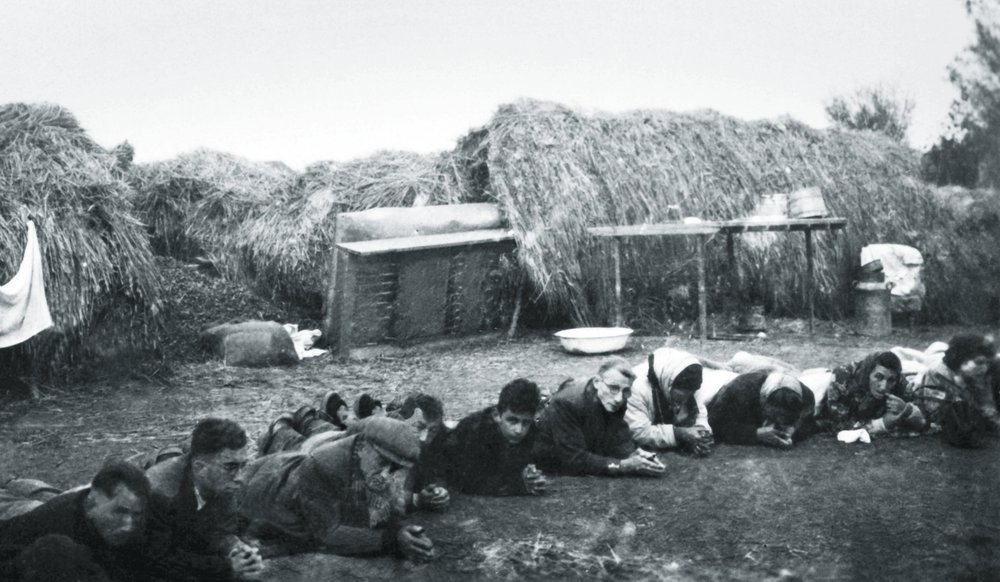
Thirty-four adults were discovered and arrested; the Bogaard patriarch, Johannes Sr. and his daughter Aagje, son Piet, and teenage grandson were also seized. The SD took photographs of a row of people lying near the haystacks after their arrest and of van Duyn, sprawled on his back in the orchard, arms thrown wide, still wearing his hat. The photos were later stolen out of a desk drawer in the Amsterdam headquarters of the SD by the Dutch resistance.
All the children survived. One, seven-year-old Arje Paz, recalled running in bare feet across a thorny sugar beet field, and a stranger arriving late that night to take him by bike to a nearby farm.
***
Johannes Bogaard Jr. was a devout Calvinist from Haarlemermeer in North Holland, just southwest of Amsterdam. Born on December 20, 1890, he spent only two years in elementary school before quitting to go to work on the family farm at the age of 8. He married Klaasje Slinger on April 3, 1912, and the happy marriage would produce thirteen children. Many would become heavily involved in the second family business, forced on them by the sudden invasion of the Nazis in 1940: Rescuing Jews.
According to the Holocaust historian Martin Gilbert, Johannes Bogaard Sr. was imprisoned briefly after the Occupation began for his public condemnations of anti-Jewish policy. His son decided to act. “He began travelling to Amsterdam, Rotterdam, and other cities to find Jews in need of protection, and to bring them back to his farm,” Gilbert writes. “As the number of Jews on his farm increased, he dispersed them among the farms of his brothers and other Calvinist friends in the area.”
According to an account published in Vrij Nederland on March 6, 1985:
Diagonally opposite the Bogaard farm stood three day labourer’s cottages, in two of which the oldest sons of Hannes [Sr.] lived with their wives and thirteen children. There was a great deal of work on the land. A little further along lived a fourth son. They were all strictly Reformed and faithful churchgoers. Even the newspaper Trouw was, to them, a left-wing paper; the Evangelical Broadcaster too liberal to follow.
“God called them to help those in hiding,” wrote Hannes Jr. in his memoirs. The Bogaards were afraid of nothing and nobody. “God has it all in His hands, and what happens is His will.”
Thus began one of the most extraordinary rescue operations in the Occupied Netherlands, spearheaded by a simple farm family armed only with their convictions. Hannes had been taught by his father from childhood to respect the Jews as God’s Chosen People, and the Bogaards lived close to their Bible. The Scriptures told them to love their neighbors. For Hannes, this meant that the Christian course of action was clear: He had to do something to save his Jewish neighbors.
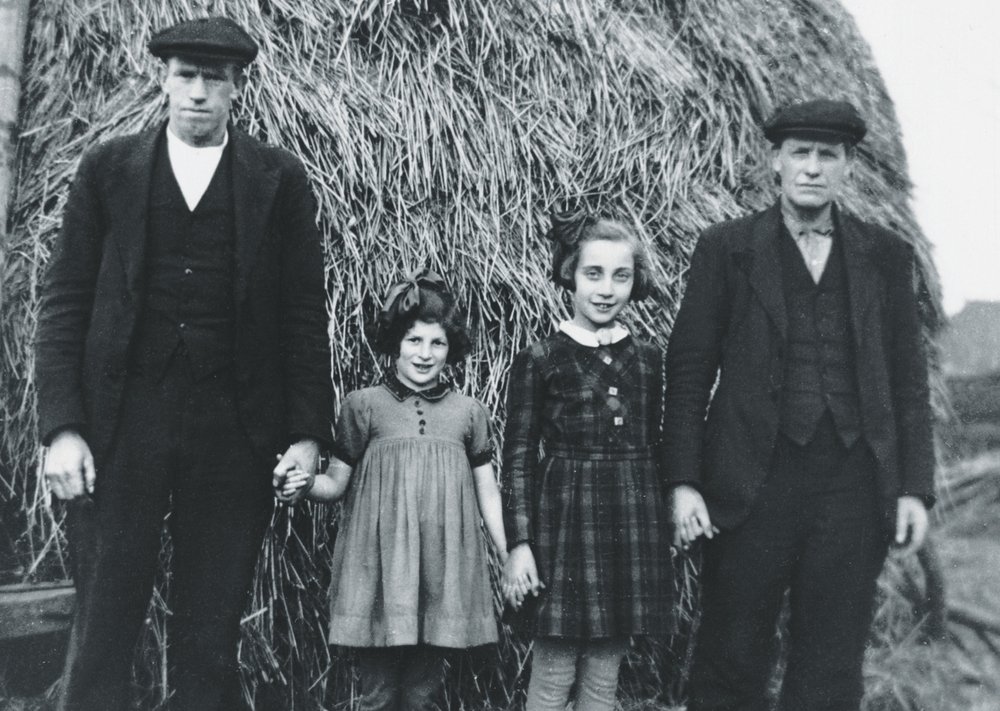
From left to right: Antheunis Bogaard, Hannes Sr., Willem, and Aagje
He began by reaching out to a Jewish family in Amsterdam and offering his help. The family asked him to hide their children. He took them to his farm. Other families heard of the farmer willing to hide Jews, and begged him to take their children, too. “Can you imagine what that meant to parents, to give their children to someone they had never seen, who they knew nothing about, not even his name?” Hannes Jr. reflected later. “I had one family with seven children. Their grief was worse, much worse than all the danger I ran.”
The danger he ran was real. In February 1941, a general strike was called in Amsterdam and other major Dutch cities to protest the first major roundups of Jews; in response, the Nazis launched a brutal crackdown and intensified their anti-Jewish policies. In a speech on March 12, 1941, Reichskommissar Arthur Seyss-Inquart issued a warning: “We will smite the Jews where we meet them and whoever goes along with them must take the consequences.” Those who helped the Jews, he added, would “meet the same fate.”
Few failed to understand what he meant. But when the deportations began in July 1942, Hannes Jr. began traveling to Amsterdam once or twice a week to bring Jews back to De Zorg.
Hannes reached out to Jewish orphanages and began to transfer the children into the countryside, one group at a time. Other Christians helped; many “host families” presented the Jewish children as refugee relatives come to stay. Others hid the children in specially constructed hiding places. At the Bogaard farm, children played openly in the orchard behind the house and even in the chicken coop, where a wire was installed that triggered an alarm, signaling the need to hide.
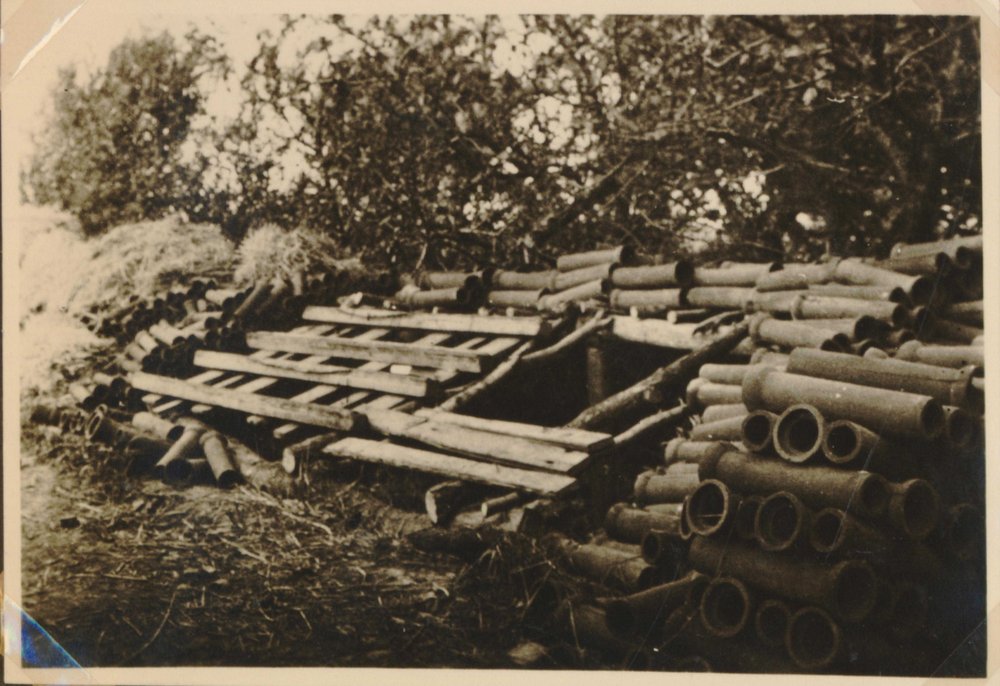
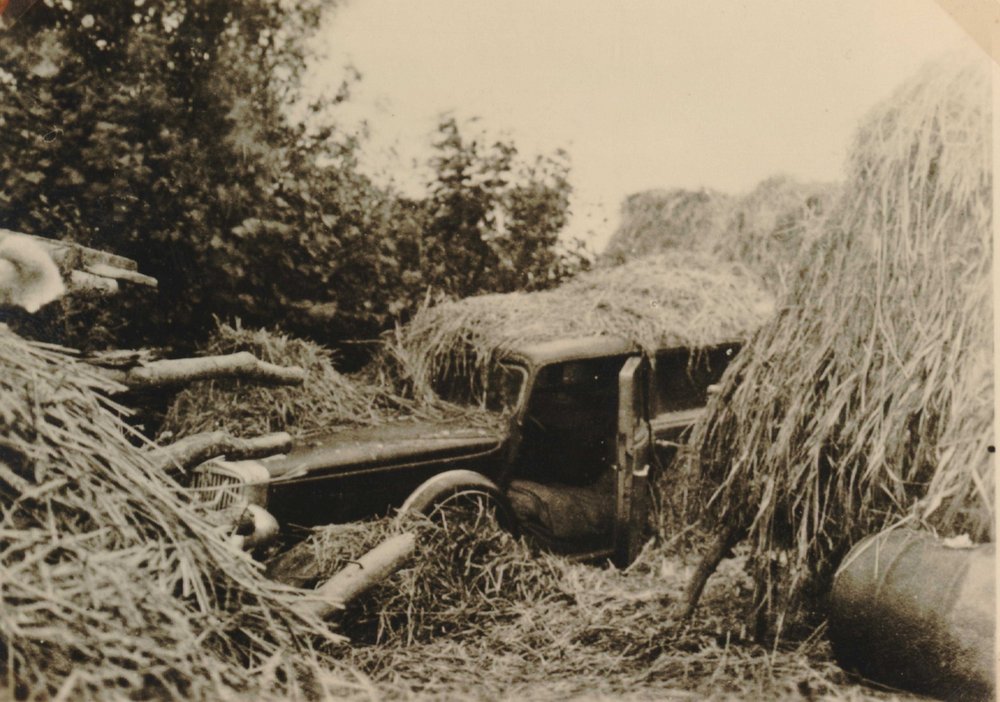
Despite the assistance of friends, family, and neighbors, Hannes soon ran out of host families. A large network of underground bunkers was built at the farm; one long bunker, built in the fields with two hay-covered exits, served as both a temporary shelter for children in transit to other families and a home for more permanent guests, with up to thirty residents at a time. There were other hiding places, too—an old car covered in manure, a haystack, holes dug in the orchard with drainage pipes and wood.
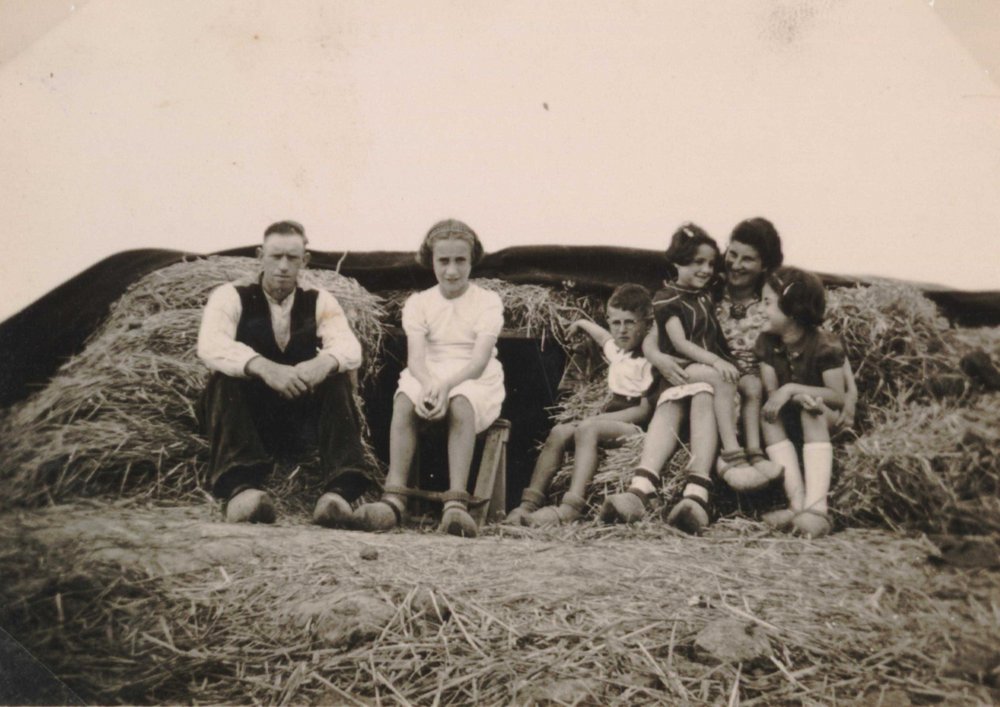
The children loved the Bogaard family and referred to their rescuer as “Oom Hannes”—Uncle Hannes. They rode horses, put on plays for the adults in the fields, and lived as normally as they could as Nazis and collaborators stalked the cities and villages, hunting them. Bounty hunters were paid five guilders for every Jew they turned in; by the end of the war, the blood-price had been raised to forty guilders per person.
As Hannes’ reputation grew, his rescue work began to consume all of his time. His family took care of the farm and their hidden guests while Hannes traveled about to find fake identification papers, money, and ration cards. The Bogaards got some help from the Dutch resistance for food. The Germans demanded an allotment of the crops from every farmer; the Bogaards farmed forty hectares and managed to deliver about an eighth to the Nazis, using the rest for those in hiding.
The hunt for food was constant. With a hundred hidden guests on the farm at one point, the Bogaards needed thirty loaves of bread per day and four sacks of potatoes per week to feed at least seventy people in hiding. Laundry alone was a herculean task: a massive wooden tub had to be manually worked with a wooden wheel every day, with the clothes hung to dry out of sight behind the house (indoors in the winter) and one person on ironing duty all day long to dry the clothing faster.
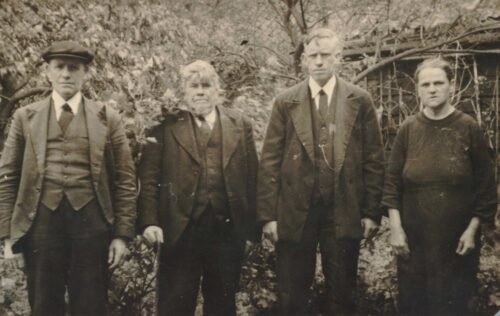
Willem Bogaard with hidden guests
Friends begged the Bogaards to be more careful, but they found it impossible to turn away the desperate people who showed up at their door. It became an open secret in the area that the family would take in anyone who asked. When one Jewish couple traveled from Amsterdam to the village to hide on the farm, they asked directions from the bus driver to the Bogaards. “Oh, the Jewish farm?” the driver asked, to snickers from other passengers. He then directed them on their way.
Dutch resistance rescuer Sieny Cohen Kattenburg, who stopped at the Bogaards on her way to another hiding place, recalled that the farm became so well-known it became dangerous. “The family took in so many Jews that the bus driver even used to announce, ‘Jews for Bogaard, this is your stop!’”
Years later, one of the Bogaards described “how the farm became a centre of an extraordinary rescue network—with the measuring stick in the window as a warning signal, with people rotating between farms across the polder, with volunteers from across the region helping to move, feed, and shelter those who could not go home.” As Cor van Straat, the head of a local rescue resistance group, put it: “The Bogaards helped everyone without distinction—it came naturally to them. Their faith was not an ideology. It was simply who they were.”
Inevitably, the farm attracted unwanted attention. The first raid was carried out by plainclothes policemen on October 6, 1942. A young man who had been arrested and beaten named members of the Bogaard network as his helpers. Fortunately, the over fifty people in hiding at the time managed to conceal themselves before the authorities arrived. As one of the Bogaards distracted the police, children were rushed into hiding places. Others fled to prearranged places at nearby farms. The Germans did not realize how many fugitives they missed.
During the second raid on November 11, 1942, Dutch Nazis stormed the farm and found 11 people in hiding, including Jews hiding in a cellar. “My father did not want to give in,” Willem recalled. “He stood with his Bible and read from it aloud as the police arrived. He read it until they took him away. My father simply said, ‘I am coming along,’ and walked out with his arms raised.”
Johannes Sr. would spend ten weeks in prison. Shockingly, a German judge released him on the grounds that “he had not acted out of greed, but in fulfillment of the commandment of Jesus Christ.” The elderly Christian was unrepentant. “As soon as I can, I will do it again,” he said. The family continued their rescue work. It would eventually cost the old man his life.
What struck those in hiding during the raids was the Bogaards’ steadfast calm. “There was a terrible panic each time,” recalled Dina Boonack-van Biesen, who was in hiding with her husband. “But the Bogaards were never afraid. They just went on. ‘God has it in his hands,’ they would say. And somehow it was true. When the inspectors came and found nothing, we could hardly breathe. But the Bogaards just stood there, calm. Their faith was something I had never seen before.”
During the second raid, three residents of the Haarlemmermeer were shot; in 1948, the Dutch police responsible for the shootings were sentenced to prison by an Amsterdam judge. During the third raid, in the summer of 1943, the warning system went off without a hitch, and the SD found nothing. One of the nearby laborers’ cottages was raided seven times, and each time those in hiding escaped.
The game of cat and mouse culminated in the deadly raid on October 6, 1944. Hannes Jr. was away, and when he headed back home by bus, he was warned not to go home. He contacted the National Organisation for Helping People in Hiding, and new hiding places were found for the escaped children. He was given a false name and identity; Hendrikus van Dijk, barge skipper. According to the Dutch Resistance Museum, he hid in the village of Renkum.
Hannes Jr.
The name Van Dijk was a safe one—the Nazis couldn’t check it, because the “D” file in the Amsterdam population register had been “disappeared” during a resistance raid; the profession was safe because the skippers’ archive in The Hague had also been destroyed. Hannes continued his resistance work as best he could until the end of the war.
The Bogaards paid a high price. Johannes Sr. was transferred from Camp Vught to Sachsenhausen, where he died on February 13, 1945. According to Yad Vashem records, Hannes’s 19-year-old son Theunis also perished in the camps, as did his brother Piet. (Other records indicate that Pieter was released from Camp Vught due to illness, but died shortly thereafter at home.) Willem was arrested after the October 6 raid and also sent to Sachsenhausen but survived and lived to old age, passing away in 1987.
In 1963, Hannes Jr. was officially invited to Israel to receive the title of “Righteous Among the Nations” from Yad Vashem for saving some 300 Jewish children between 1941 and 1945. A tree was planted in his honor.
“We have to look not at what we lost, but what we saved,” he reflected. “God called us to this work, and He also gave us the strength for it. As Netherlanders we could not do otherwise.”