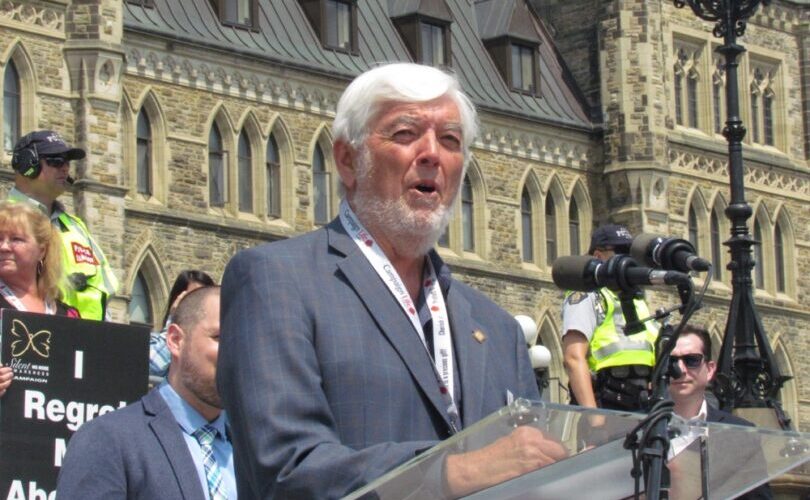
Jim Hughes, the Canadian movement’s most prominent leader for more than four decades, died on the morning of May 18 at 83 years of age. Tributes have been pouring in from across the movement as pro-life activists recall his tireless commitment to the cause and his impact on their own lives.
Hughes gave up his business career in 1978 after seeing the reality of abortion at a Right to Life presentation; his wife challenged him to work in the movement for just two years while they lived off her nurse’s salary. In 1984 – that’s six years later, if you’re counting – he took over Campaign Life from retiring president Kathleen Toth. He had a front row seat to the fight for the unborn for the rest of his life.
Hughes was a consummate storyteller and would launch into memories of battles won and lost at the slightest provocation. I recall Hughes at one event telling us about his run-in with the infamous abortionist Henry Morgentaler at a downtown Toronto restaurant, in which he told Morgentaler that he was still praying for him. Morgentaler was both taken aback and gracious in response. I’m sure hundreds of others heard the same story over the years.
From a historical perspective, the most consequential fight Hughes was involved in was his very first. Campaign Life was founded in May 1978; the following month, Prime Minister Pierre Trudeau introduced the Constitutional Amendment Bill, which included a Canadian Charter of Rights and Freedoms. Key pro-life leaders – including Jim Hughes – recognized that a charter which did not include explicit protections for the unborn would inevitably be used to justify a regime of abortion on demand.
Campaign Life Coalition put all its resources into fighting the charter, sending President Kathleen Toth, Gwen Landolt (as legal counsel), and psychiatrists Dr. Edward Rzadki and Dr. Michael Barry to the Special Joint Committee on the Constitution of Canada session on January 8, 1981. Despite opposition by some members, they were given permission to speak – although NDP MP Lorne Nystrom marched to the back of the room to show his objection to the presence of Campaign Life and returned once they had finished. (He then threatened to sue if his behavior was publicized; he withdrew the threat when it turned out it had all been captured on video.)
Campaign Life worked ferociously to ensure that the charter either included rights for all Canadians or was killed entirely. They ran a full-page ad in The Catholic Register, warning – prophetically – that the charter as written would lead to radical social changes, including the legalization of same-sex “marriage.” Hughes and Campaign Life were struggling not only to motivate the rank and file, but Catholic leaders, as well – they were accused of baseless fearmongering. The editor of the Register was fired for running the ad.
We will never know if the efforts of Campaign Life and the pro-life movement to defeat the charter would have succeeded; history tells us that when Cardinal Emmett Carter, with explicit assurances from Justice Minister Jean Chretien, published a statement of neutrality on the issue in the Catholic Register, Liberal MPs rejoiced that they could now vote for it in good conscience.
Years later, Jim Hughes said, Carter would tell him that he’d been lied to. That day, a sad scene unfolded at the Campaign Life offices. Pro-life leaders felt that they were close to beating the charter. The effort, right across Canada, had been herculean, but there was a sense that victory was possible. When they heard the news, darkness seemed to descend. “I saw pro-life leaders, many of them, extremely shocked, devastated, grown men and women in tears, crying,” Steve Jalsevac recalled. “That’s what I saw. It’s like someone put a knife in their back. It was that close.”
Although few Canadians understood it at the time, the battle over the Canadian Charter of Rights and Freedoms was the most consequential political fight of the 20th century. It would utterly transform and define Canada for the rest of her history. The story of the pro-life movement’s resistance to the charter has been largely ignored by historians, even though the warnings of prominent pro-life groups were prophetic.
Every dire warning delivered by pro-life leaders during those pivotal years would be borne out in the decades that followed with grim, uncanny accuracy. Jim Hughes was one of those few who saw with clarity that the charter, without rights for the unborn, would be the greatest tool the sexual revolutionaries ever possessed. Hughes would tell the story over and over again to younger pro-lifers in the years ahead – of those early days, when it seemed as if history was up for grabs and Trudeau’s revolution could be stopped.
Two years after the charter was signed in 1982, Jim Hughes became president of Campaign Life. He would serve in that position until 2018. Like his fellow warriors, he saw his predictions borne out, one by one – but he never stopped fighting. He knew that regardless of the circumstances, unborn babies needed a voice. He lent them his to the last.
Very interesting bit of history. If I recall correctly, Trudeau and/or Chrétien added the notwithstanding clause in case the courts ever recognized a charter right to abortion (they technically haven’t at this time, though they obviously would if an abortion case were to make it up to the Supreme Court of Canada in 2026). Is this correct? If Americans lived under the Canadian Charter, Roe v. Wade would’ve been irrelevant from day one because the pro-life states would have invoked the notwithstanding clause and continued to enforce their abortion laws.
At the end of the day, of course, we know the Charter by its fruits.









Very interesting bit of history. If I recall correctly, Trudeau and/or Chrétien added the notwithstanding clause in case the courts ever recognized a charter right to abortion (they technically haven’t at this time, though they obviously would if an abortion case were to make it up to the Supreme Court of Canada in 2026). Is this correct? If Americans lived under the Canadian Charter, Roe v. Wade would’ve been irrelevant from day one because the pro-life states would have invoked the notwithstanding clause and continued to enforce their abortion laws.
At the end of the day, of course, we know the Charter by its fruits.