International Politics
Dave Smith Gets His Comeuppance
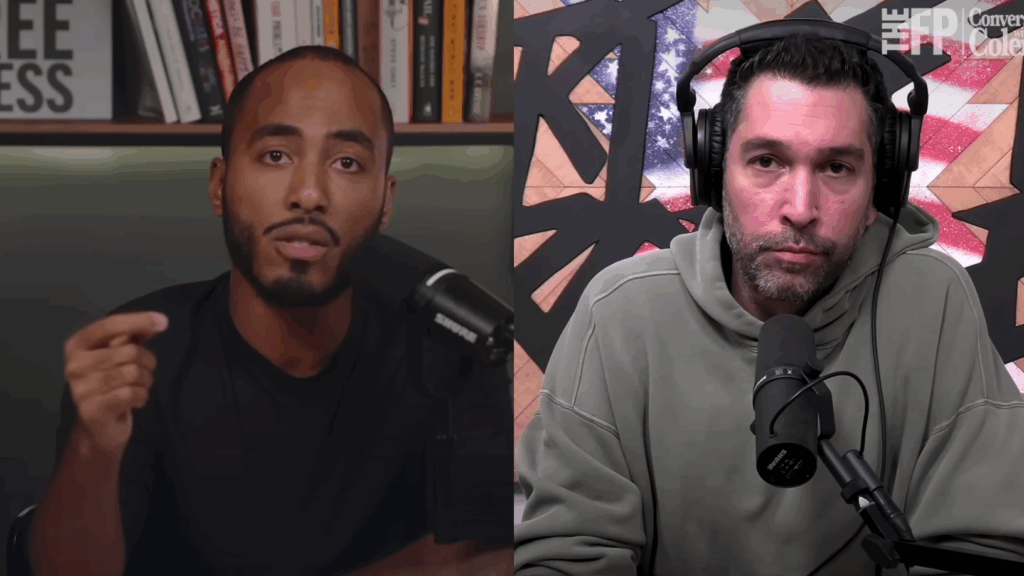
Watching the debate between comedian and political podcaster Dave Smith and writer Coleman Hughes on the Middle East, Israel, and American Empire earlier this month was like seeing an unjust war against an unarmed combatant unfold, relentlessly, over three and a half hours. Hughes came with historical context, nuance, and a well-researched understanding of the Middle East. Smith came with his bag of pundit party tricks, and almost from the beginning, he was left scrambling at the bottom.
Over the past several years, Smith has become one of the most prominent anti-Israel voices on the Online Right, appearing on Joe Rogan’s podcast thirteen times in the past five years and racking up over 830,000 followers on X. In April, he appeared on The Joe Rogan Experience alongside journalist Douglas Murray, who declined to debate Smith and instead chose to excoriate Smith’s lack of expertise. Murray’s point—that expertise matters—was correct. Murray’s strategy, as Hughes’ methodical demolition highlighted, was the wrong one. On issue after issue, Hughes had Smith on the ropes.
Hughes debunked Smith’s claim that Israel pushed the U.S. into war with Iraq, noting that Ariel Sharon had, in fact, consistently advised Bush against invasion and occupation; Israel only supported it after the Bush administration made it clear that it was a done deal. Smith’s narrative didn’t just fall apart in the face of the evidence Hughes provided; it collapsed. Hughes also challenged Smith’s narrative about the allegedly all-powerful Israel lobby which, he noted, is tiny compared to most, and was in fact outspent by the dentist’s lobby during the Obama years. As Hughes noted in his summary of the debate:
[T]he Israelis couldn’t get Bush to add one little word to his Palestine speech in 2002. For 36 years, they could not get the U.S. to recognize Israeli sovereignty over the Golan Heights, which would have required one stroke of the presidential pen. They couldn’t get Bush to mount a campaign against Syria’s admission to the UN security council in 2002. They couldn’t get Bush to bomb Syria’s nuclear facilities in 2007. Yet we are supposed to believe that a country with the size and population of New Jersey, which couldn’t get America to do any one of these smaller favors, somehow got us to fight an entire war—and they accomplished all of this with a lobbying budget the same size as Big Dentistry?
If it weren’t such a serious slander, it would actually be laughable.
Hughes also addressed Smith’s favorite talking point—a memo described by an unnamed member of the Defence Department to General Wesley Clark detailing a plan for regime change in seven countries. Clark never saw the memo, but Smith insisted that because Clark’s source had told him that a “decision had been made,” the memo was clearly operative.
“Everyone else in the room does not say the decision had been made,” Hughes noted, after citing a series of first-hand accounts. “Your only evidence is the guy who never read [the memo]. If you were a historian writing a book, you’d have to cut this out of the book because you’re relying on the hearsay of someone who never even read the document.”
A visibly frustrated Smith responded: “I’m not a historian writing a book. I’m a guy talking about these issues to the American people. You can decide for yourself if you find that to be a pretty interesting story or not.” Indeed. That sums up the difference between having an evidentiary standard based on the historical method, and a “guy talking about these issues” and telling a “pretty interesting story” that you—that is, the viewer—can judge. That’s a great podcasting strategy. It is not historiography, and it is not a remotely reliable way to get to the truth.
Dave Smith’s worldview defines the difference between simple and simplistic. His shtick works well when he is speaking with someone like Rogan, who isn’t well-versed in the subject matter. His rapid-fire delivery peppered with context-free half-quotes, hearsay, and anecdotes is particularly effective on platforms like Piers Morgan’s political Jerry Springer Show. But when faced by someone who patiently rebuts him, provides the omitted sections of selected quotes, and adds essential historical context, Dave Smith has nothing. His narratives are an exercise in backfilling, not truth-telling.
When Hughes asked Smith about the potential consequences of Israeli withdrawal and a likely Hamas takeover of the West Bank, Smith was alternatively dismissive and insistent that such questions be disregarded. He frequently acted as if such scenarios were ridiculous, a tactic that works on Rogan but not on Hughes. His conclusion: It’ll all work out in the end. Smith is burdened by what has been (Zionism in particular), but unlike those who must actually make decisions that will determine the course of countless lives, he is remarkably unburdened by what will be.
My primary issue with Dave Smith is not that he gets history so badly wrong. It is that he serves as a halfway house to genuinely sinister and antisemitic figures who go much further in their historical revisionism. Smith is not a Holocaust denier or a Hitler-lover, but he has no problem sharing platforms with them. He’s gone on Fight Back with Jake Shields; Shields is a vicious Jew-hater who claimed that not “a single Jew died in the gas chambers” and praised Hitler many times. He recently interviewed Nick Fuentes, giving the Nazi apologist and Holocaust denier an opportunity to appear more moderate and mainstream. During the first part of their chummy conversation, Smith even told Fuentes that the two of them were the “elite of the elite” compared to most media commentators.
Smith is also famously close to Candace Owens, who has taken a break from her game of “Pin the Penis on the French First Lady” to craft conspiracy theories about Charlie Kirk’s murder and, of course, the Jews and Israel. Owens has claimed that both Joseph Stalin and Mustafa Kemal Atatürk were Jewish in her efforts to blame every genocide on those she regularly refers to as “demonic.” (Even Fuentes has complained that Owens is making honest antisemites look bad with her shoddy research.) Owens’ investigative journalism is neither investigation nor journalism, and her modus operandi is something approximating Nancy Drew on mushrooms. To his credit, Smith has dismissed the idea that Israel was responsible for Kirk’s murder—but he has consistently defended Owens’ “true integrity.”
Smith is an anti-war libertarian. The crowd he runs with, however, is stacked with crazed conspiracy theorists, self-confessed Nazi apologists, Hitler defenders, Holocaust deniers, and genuinely venal people. That is his choice. Based on his choices and associations, it appears that in Smith’s view, the Overton window of acceptable debate includes relitigating basic historical facts about the Holocaust and Nazism, with the primary common ground being opposition to Israel. That is important context when considering Smith’s own revisionism, discretion, and yes, intelligence.
In his post-debate column, Coleman Hughes observed that in order to combat the rise of conspiracy theorists, figures like Dave Smith—who is, I note again, one of the least malign figures in this online ecosystem—must be confronted with hard evidence. Hughes is right, and over three and a half hours, he proved it.
Related Posts from The Bridgehead: