This essay was published in the 2024 print edition of The European Conservative magazine.
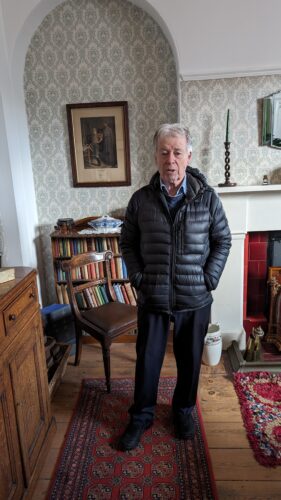
I met Jim Wight at The World of James Herriot visitor centre in Thirsk, North Yorkshire, better known to millions of readers as the Farnon-Herriot veterinary surgery of Darrowby. Eighty-one-year-old Jim Wight is the son of James Herriot—the pen name of Alf Wight—and worked as a vet with his father and Donald Sinclair (Siegfried Farnon in the books) as a vet for decades. Viewers of Channel 5’s widely acclaimed TV series “All Creatures Great and Small” saw him arrive as a baby in the recent Christmas Special of Series 4; Herriot readers will recall “Jimmy” making his appearance in All Things Wise and Wonderful (1977).
Wight, along with his sister Rosie, is the guardian of his father’s legacy; he wrote The Real James Herriot: A Memoir of My Father in part to set the record straight after the publication of Graham Lord’s Herriot biography in 1997. Wight ushered me in through the red front door of the surgery. The surgery and the first Herriot home have been restored to the way things were described in the books, so much so that when Herriot’s wife Joan—Helen, in the books—saw the restoration for the first time in 1999, “she had a lump in her throat, because this is exactly how it used to be.” Wight would know—it was his home, too.
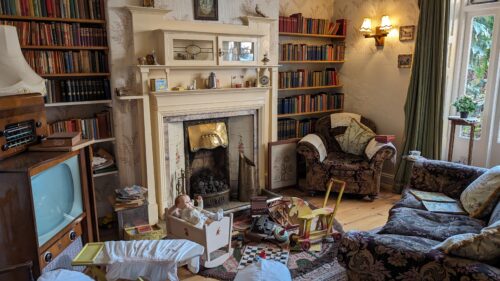
“These are the original tiles, well over 100 years old,” he told me in the foyer. Historic paintings hang in the front hall. Wellington at Waterloo, the death of Nelson. In the adjoining family room, set up with the chairs pointing towards the fireplace and the table scattered as if the Wights had just ducked out for a moment, a portion of Herriot’s book collection sits on bookshelves. Dickens, Walter Scott, Arthur Canon Doyle, and P.G. Wodehouse—who reduced Herriot to helpless laughter and clearly influenced his own work—were favourites. Across the hall is the large dining room, where a model of the famous Mrs. Pumphrey (real name: Marjorie Warner) and her Pekinese Tricki Woo sit on a chair.
“We worked like dogs,” Wight recalled. “There could be twenty or thirty visits a day.” He smiled with nostalgia as he pointed and talked; there was the black phone that would ring from some far-flung farm; the vets would race through the hallway, down the garden, and leap into the brakeless black 1938 Austin Seven, which had to be started with a crank, and then off through the dales to some hill farm, where more often than not the job would require stripping off on some wind-blasted pasture to assist a difficult lambing. Veterinary work in the 1940s and ‘50s was not for the faint of heart.
We spent an hour in The World of James Herriot, making our way through the surgery and the apothecary filled with potions. In the kitchen was a massive range oven that was, Wight noted, much smaller than many of the farmhouse ranges, which were used to cook food and warm the family and newborn lambs and piglets, too. Hanging next to the range was a needlework quote that summarized the attitude of many farm folk:
The Beauty of the House is Order
The Blessing of the House is Contentment
The Glory of the House is Hospitality
The Crown of the House is Godliness
Some of the stories Wight told me I recognize from the Herriot books; hearing the stories from him, in his wonderful Yorkshire accent, is a Herriot fan’s dream come true. At several points, walking through the surgery, other visitors realized who he was as they overheard his stories; their eyes grew large. He graciously answered all questions. At several points, Wight stopped, looked around, and shook his head. “It was just like that. Just like that.”
Alf Wight graduated from Glasgow Veterinary College in 1939 and secured a job in Yorkshire in January of 1940. His boss, Donald Sinclair, owned the practice at 23 Kirkgate in Thirsk, and he needed a young vet to look after it while he took his Royal Air Force training. Alf soon met Joan Catherine Anderson Danbury (Helen); unlike most of those described in the books, Joan is least like her literary counterpart. She was the secretary at a corn mill in Thirsk, not a farmer’s daughter, and she was an excellent cook. She did, however, have a number of suitors and one broken engagement before meeting and marrying Alf on November 5, 1941.
A year after getting married, Alf also trained in the RAF, despite veterinary practice being an exempt profession. “His house was bombed in Glasgow, and he was infuriated by it,” Wight told me. He was discharged as a leading aircraftman for medical reasons in July 1943. He and Joan had two children: James (Jim) in 1943 and Rosemary in 1947. In the 1960s, he began to write short stories and “bombard publishers with them”; they were rejected. The first book he sent in was titled The Art and the Science, a reference to the way veterinary work in the 1940s and ‘50s was often show and guesswork. Wight still owns the original draft and says that it’s a good thing it was rejected. Alf got better with every rewrite.
If Only They Could Talk was published in the UK in 1970, followed by It Shouldn’t Happen to a Vet in 1972. The two books were combined into one volume and sold in the U.S. under the title All Creatures Great and Small. It was a runaway bestseller. He wrote eight books in all, selling over 80 million copies translated into 36 different languages. Despite his gruelling hours of veterinary work, Wight told me, Alf wasn’t financially stable until the books were published; at his silver wedding anniversary, “he only had twenty quid in the bank.” Alf had always wanted to build a nice home for his wife, and his success allowed him to do so. It cost him 2,000 pounds. Incidentally, that house has just gone up for sale.
The locals never made a big deal about Alf’s books, although they figured out that he was James Herriot almost immediately. Jim Wight had been sworn to secrecy, but in his memory, this lasted less than a month. He was at the market square shortly after publication, he told me, when a farmer came up to him.
“I’ve just read a book by a vet named Herriot,” the man informed him.
“Oh?” said Wight, who hadn’t said a word to anyone.
The farmer nodded. “It’s your dad, isn’t it?”
“What makes you think that?” Wight replied cagily.
“Come on,” the farmer replied. “The way he described Siegfried? That’s Donald Sinclair to a tee!”
Another farmer commented casually to Alf one day that he’d read one of his books. “Oh?” Alf replied cautiously. “What did you think?” The farmer replied: “Why, they’re about nowt!” (“Nowt” was Yorkshire slang for “nothing.”) It was a backhanded compliment that testified to how completely Alf, as Herriot, had captured life in the Yorkshire dales. “He never talked about his books,” Wight recalled. “He never changed. That was his secret. That’s why he’s popular around here. He was a proper gentleman, dead straight.”
“The only time he ever got castigated for his books was by a little man named Mr. Smedley,” Wight chuckled. “I can see him now—a customer from a nearby village, a little man with a club foot, he was. He berated my dad: I haven’t been in any of your books, Mr. Wight! When are you going to put me in one of your books? He was really upset about it.” Some characters were recognizable, but Alf ensured that others could not identify themselves by combining people, changing locations, and even switching the sexes of the people he was writing about. Despite that, Wight insists that nearly all of the stories in the books are true. He witnessed some himself and heard the others from his father long before they showed up in print.
Donald Sinclair was less pleased about his portrayal as Siegfried; he was simply too eccentric to recognize himself. Wight says that Alf actually hid the extent of Sinclair’s neuroticism. “Donald was virtually impossible to work with, but he was a decent man,” Wight chuckled. “He would never do you a bad turn. You got what you saw with him. There was no hidden agenda. I never heard Donald talk about somebody behind their back. I don’t think he’d survive the modern age. He was too erratic, but very well thought of because the overriding thing about him was his decency.” For generations of readers, Sinclair and his brother Brian—Tristan, in the books—were favourite characters.
There were stories that Alf wouldn’t tell, of course. In one instance, a lady’s dog had died, and they’d cremated it. She requested the dog’s ashes, which were long gone. Sinclair was determined to give her what she wanted and headed to the ash pile at the bottom of the garden. “Donald comes back with a palmful of ash, with a little velvet cushion,” Wight laughed. “The dog had been dead [for] six weeks, but the ashes were red hot [and] burnt a hole in the pillow. Dad never would’ve written that. He didn’t do black humour.” I asked how the story ended; Wight didn’t know. Mortified, Alf had bolted from the room.
Alf Wight achieved the singular distinction of becoming a literary icon while remaining a practicing vet. He became friends with crime novelist Dick Francis; he went on TV and met celebrities. The Queen herself was a fan. He was invited to meet her in 1980, and Wight told me that Alf “found her the most easy woman to talk to, with a very acute sense of humour. She told him that his were the only books that repeatedly made her laugh out loud.” Alf was a Tory, but when he met Harold Wilson and Edward Heath, he found that he preferred Wilson. “What a grand little man he is. He’s read my books. He loves dogs. He’s a big football fan. I could have spent all night with him.”
Despite his huge success, Alf never left Yorkshire. Most British writers did, and it is easy to see why—Alf was paying 83% income tax and 98% of investment income. Wight asked him once why he didn’t just go to one of the Channel Islands for a couple of years and save millions. Alf’s answer was simple. “I don’t want to do that. I like living here.” Wight chuckled. “He said to me, ‘How much money do you want? I don’t want a yacht in the Bahamas. I don’t want a helicopter. I don’t want a palace. I want to go to the same places I’ve always enjoyed: walking in the hills, going to the local football matches.’ I think he had his priorities right.”
Wight nodded reflectively. “Right? How much money do you want, Jonathon? It’s a good point, isn’t it? He could have left the dales and the practice … for what? A bigger bank account, away from the things that he loved?” He’s right, of course. A man who is content is already rich, and I’ve often thought that the gratitude James Herriot exuded made him the quintessential conservative; it is gratitude and love for our homes that drives the desire to conserve and protect. Alf could have gone anywhere or had anything, but he believed he already had everything a man could want. He worked as a vet for fifty years, almost right up until his death from cancer in 1995.
This, despite the fact that Alf struggled with depression. I asked Wight if the empathy and sensitivity on display in Herriot’s books were in part due to his own struggle with mental illness. “It could have done,” he replied thoughtfully. “I’ve never thought of that, actually. Right until he died, he had periods of melancholy.”
In the gift shop, Jim Wight laid out maps on the counter and advised us on the best route through the Yorkshire Dales. First, we took some time to walk around Thirsk. With a population of scarcely 7,000, it is still a small village; in 2023, the Sunday Times proclaimed Thirsk one of the best places to live in the North: “The heart of James Herriot country is Yorkshire at its traditional best, offering a hearty combination of class, countryside, and convenience.” That was certainly our experience; we stayed at the Fourways Guesthouse, a short walk from the cobbled town square, and the proprietor Mark—his family knew Alf’s daughter Rosie well—could not have been more hospitable.
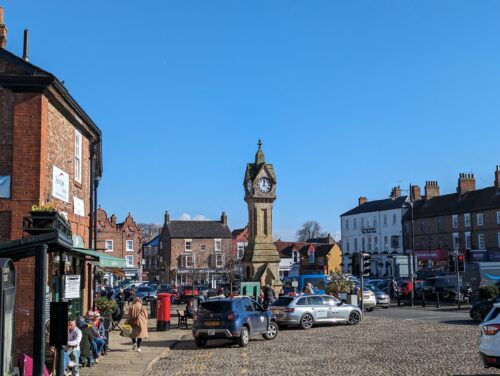
Thirsk is a market town, and the square boasts a magnificent clock erected in 1896 to commemorate the 1893 wedding of the Duke of York to Princess Mary of Teck (later King George V and Queen Mary). It was crisp and sunny, and vendors were selling flowers and farm produce. On one side is the Golden Fleece Hotel, which opened in 1810 and boasts an enormous, oak-beamed fireplace dating from the 1500s. St. Mary’s Church is even older, dating from the 14th century. Alf and Joan got married there in 1941. Legend has it that the Earl of Northumberland, Henry Percy, was murdered in the square in 1489.
There are also several Methodist churches in the village; Wight told me that the area was very religious and primarily Methodist, “especially up in the dales.” Fifty years ago, all of the churches were packed each Sunday. The great Methodist revivalist John Wesley preached in the square in 1763, recording in his diary: “At six I began preaching in the street at Thirsk. The congregation was exceedingly large. Just as I named my text, ‘What is a man profited if he shall gain the whole world and lose his own soul?’ a man on horseback, who had stopped to see what was the matter, changed colour and trembled. Probably he might have resolved to save his soul had not his drunken companion dragged him away.”
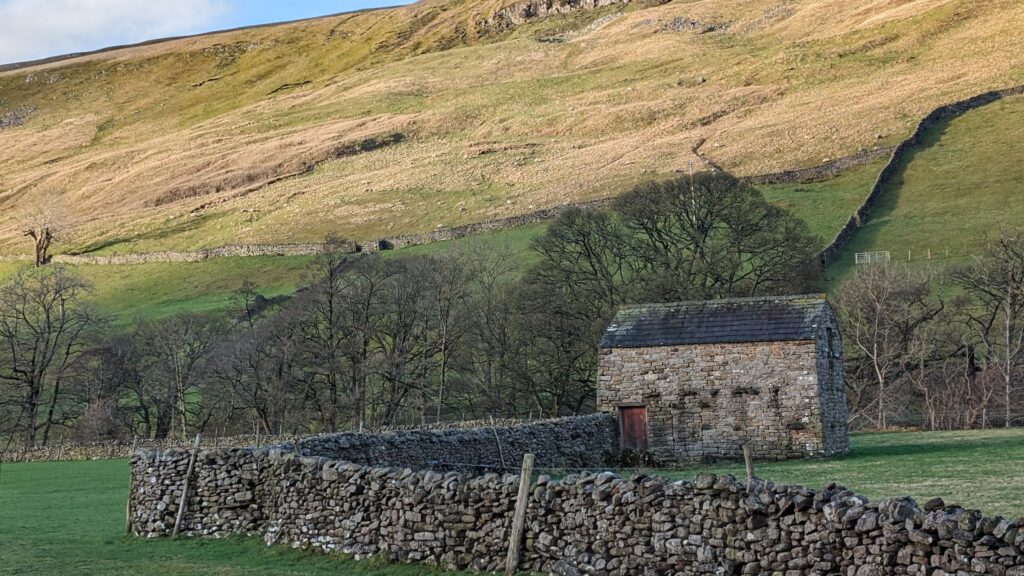
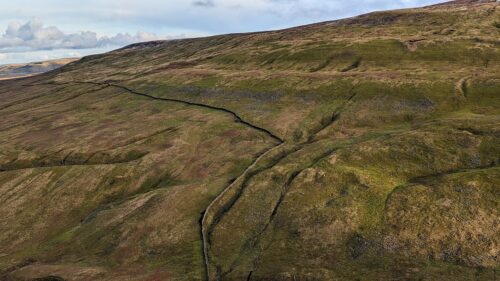
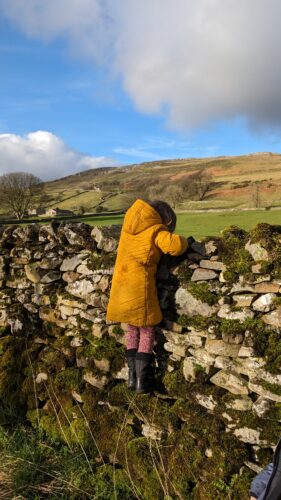
We left Thirsk and headed for Wensleydale, winding through pastureland and heading up into the dales, where low stone walls with moss effortlessly climbed steep slopes. We pulled into the village shortly after passing Bolton Castle, where Mary, Queen of Scots, was imprisoned for six months. The walled roads were so narrow that it was impossible to stop for photographs, and the ancient stone bridges over clear, burbling creeks only allowed one car at a time. Squat gray drystone cowsheds dotted the landscape. Many of them were centuries old; most of them were still in use. Ring-necked pheasants frequently fanned out from the road as we drove by. Out in the countryside, it felt as if nothing had changed. In the dales, it is still Herriot’s Yorkshire.
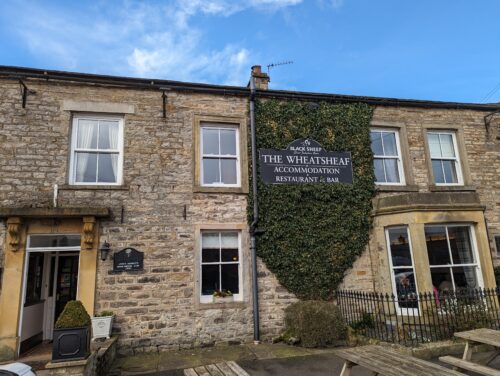
We had lunch at the Wheatsheaf Inn, where Alf and Joan spent their short honeymoon in 1941 as war loomed. It is a snug, traditional pub unmarred by interior designers; the front door opens into a cozy sitting room with a massive stone fireplace. Next to our table, the old guest book was displayed in a showcase, open to the page where Mr. and Mrs. Alf Wight had signed more than 80 years ago; a few lines down the page was the signature of Greta Garbo, who had stayed there for one night in January 1942 after entertaining troops at Catterick Garrison. Wensleydale is one of dozens of little villages and hamlets strung along the dale valleys, each with its own ancient stone church, cluster of little shops, and chimneyed rowhouses.
In between are the farms, some of them perched impossibly high up in the dales, where James Herriot spent his adult life.
There are still some small farms, but the agrarian life of Herriot’s era has vanished. “The animals all used to be named—Snowdrop and Bluebell, and so on,” Wight recalled. “Now, they’ve got numbers. Farming is a numbers game. That’s all gone. It’s all gone, Jonathon. It’s in the past. That’s my dad’s legacy—he’s left us a terrifically readable record of the way life was.” Farmers are still Herriot’s most loyal audience. “The farming community has read his books inside out. One of the countries that’s very big on him is Ireland,” Wight said. While speaking at a farmer’s meeting in Ireland once, he expressed surprise that Irish farmers were so interested in Yorkshire farmers.
One of them looked at him, taken aback. “’We’re all the same, you know. Yorkshire farmers, Irish farmers, Scottish farmers … They have the same outlook on life, don’t they?”
Wight worries about the survival of farm life. “The small farmers are being dictated to by the supermarket,” he told me. “I don’t know how they keep going, to be honest. I think a lot of them farm because they love it, and what else can they do if they live up in the Yorkshire dales? Tourism or farming. I certainly worry about it. I don’t think they get a fair crack. People overlook the fact that farmers are not just there to produce food. They are the guardians of the countryside. All these tourists come up to the Yorkshire dales and say, What a wonderful place! Why? Because of the farmers! Who is mowing that field? Who has repaired that wall? Who is taking care of those sheep? The cattle?”
“Some idiots in this country—the rewilders, they call them—‘let’s get back to rewilding; we don’t want any cows because they damage the environment; let’s bring back wolves and lynx,” Wight went on. “I saw a bit of rewilding during hoof and mouth disease in 2000, up near the Lake District, where for several months there was no stock because they’d been slaughtered. You should have seen the state of those fields. Thistles, nettles, brambles—what a sight! The farmers look after the countryside. People forget this. Farmers don’t get credit for this.”
A key reason, in Wight’s view, is that many of the people pushing the environmental policies are city folk with little real experience of the countryside. “Just Stop Oil!” he scoffed. “How am I going to heat my house? I haven’t got any gas. There’s no gas up to these places. You know why they don’t say ‘Just Stop Gas’? Because that’s the urban method of heating. But it’s a fossil fuel, just like oil. Why don’t they march against gas? Oil is all we can use—or logs and wood, like I do. I don’t know who actually looks out for small farmers.” King Charles III, Wight observed, is a defender of the countryside—the hedgerows, stone walls, and natural beauty. “He speaks for the countryside. He’s also very much into the environment—the Net Zero 2030. Come on. That’s not going to happen.”
With the changes in the countryside, of course, came changes to the veterinary practices. “My father would be turning in his grave,” Wight reflected as we talked in the old surgery. “His old practice does no farm work at all. We’ve been taken over in this country by big corporate organizations; all the practices have. It’s sad. In my opinion, and in the opinion of a lot of older vets, the priority is profit now. With my dad and Donald Sinclair, it wasn’t profit. It was the welfare of the patient.”
With the launch of the new Channel 5 series, James Herriot’s books have been released with new covers, and there has been a renewed interest in all things Yorkshire. “The Herriot books have definitely had a bit of a resurgence,” Wight told me. “It’s incredible that we’re still signing contracts for the books in places like Hungary and the Czech Republic—all over the world, they’re selling. The digital age goes too far sometimes, and it’s nice to speak to human beings and get back to basic things. I think that’s why the Herriot books still appeal to people. We’re talking about, in some respects, a better time. Herriot’s books are therapeutic.”
The first All Creatures Great and Small TV adaptation was the BBC series of 90 episodes that ran from 1978 to 1990, and it is still close to Wight’s heart because it stuck so close to the original Herriot books—at Alf’s insistence. The new show, he says, is brilliantly acted, filmed, and produced, but it has changed many of the stories. “We accept it,” he said. “They contact us all the time, my sister and myself, to make sure there’s nothing we disapprove of. There was one episode where he had to conjure some figures to pass a beast for tuberculosis that actually had it. My dad would never, ever have done that. He was totally honest. He once fell out with one of his best friends because he wouldn’t pass a pig with tuberculosis.”
“We appreciate the producers, who keep us in the loop, but we can’t do anything about the extra stuff they put in. In fact, I said to Sam West—who plays Siegfried brilliantly well—what I’m going to say to him when I see him soon is that I’d love to hear him acting James Herriot’s dialogue from the books,” Wight added. “The Tristan-Siegfried dynamic.” The series is now Channel 5’s most popular show ever—no sex scenes, no killing, no intrigue—just the high drama of ordinary life in the Yorkshire dales some eighty years ago. As it turns out, for many people, it was just what the doctor ordered.
As Wight launches into another story I’ve never read in Herriot’s books or in his own memoir, I ask him if he has considered writing another book. “Oh, yes,” he replied. “There’s all sorts of things I could write about.” His wife, as it turns out, keeps telling him that he should. There are many stories left to tell—about Siegfried, for example, or the Yorkshire farmers. If he did do it—and Wight is deliberately non-committal—that’s what he would write it about. “I’d probably call it With James Herriot and Friends. I’ve thought about it. That’s all I can say.”
I hope that he does. I’d like to spend more time with James Herriot and friends. The proposed title reminds me of something Alf wrote in one of his books, about a visit with farm folk. “You don’t find people like the Bramleys now; radio, television, and the motorcar have carried the outside world into the most isolated places, so that the simple people you used to meet on the lonely farms are rapidly becoming like people anywhere else,” he wrote. “There are still a few left, of course—old folk who cling to the ways of their fathers, and when I come across any of them, I like to make some excuse to sit down and talk with them and listen to the old Yorkshire words and expressions which have almost disappeared.”
2 thoughts on “James Herriot’s Yorkshire: The World of All Creatures Great and Small”
James Fraser says:
I have been introduced to Alf Wight through your articles here. Our family has enjoyed them very much. They have made for great bedtime reading. As one who was raised on a farm, the many connections to a bygone world help me pass them on in some minimal way to them. Hoping to pick up Durrell’s books after your recomendation.







I have been introduced to Alf Wight through your articles here. Our family has enjoyed them very much. They have made for great bedtime reading. As one who was raised on a farm, the many connections to a bygone world help me pass them on in some minimal way to them. Hoping to pick up Durrell’s books after your recomendation.
Awesome!