This essay was first published in the print edition of The European Conservative
There is a type of academic who can only get noticed by attacking the legacies of greater men and women, and a prime example was cited by Matthew Dennison in The Spectator in his essay “Don’t Cancel Beatrix Potter.” The beloved children’s author has become the target of “specialist in postcolonial literature” Dr. Emily Zobel Marshall, who hilariously claims that Potter failed “to acknowledge her indebtedness to an oral storytelling tradition of enslaved Africans working on American plantations” and that this contributes to “a damaging and recurring appropriation of Black cultural forms that continues today.”
This is frivolous stuff, and Marshall’s claims are a parasitic attempt to gain fifteen minutes of fame by slandering a woman who cannot defend herself. Dennison handily rebuts Marshall, and I’m glad he did—but I can’t help but think that fortunately, some writers are uncancellable. Potter’s books have sold 250 million copies. Her legacy is just fine. Her characters will continue to be household names for countless children, while Dr. Whatserface will have to find a new target if she wants to trigger further discussion of her own work. People who take these accusations seriously should not be taken seriously.
I do, however, think that a study of Potter’s life has something to contribute to current cultural conversations—not in “postcolonial literature studies,” but in the discussions unfolding in traditionalist circles on how to respond to our civilizational moment, in which many things appear to be ending.
Paul Kingsnorth has been grappling with the question of how to live in this revolutionary age on his Substack “The Abbey of Misrule,” noting at the outset that: “The storm is here and an age is ending, but new and old hearts stay steadfast on the margins. God is not mocked, and reality bats last. In an age of Big Everything, small remains beautiful and shall, in the end, inherit the Earth.” In his concluding essays, he suggests that becoming rooted in “people, place, and prayer” are key parts of the answer.
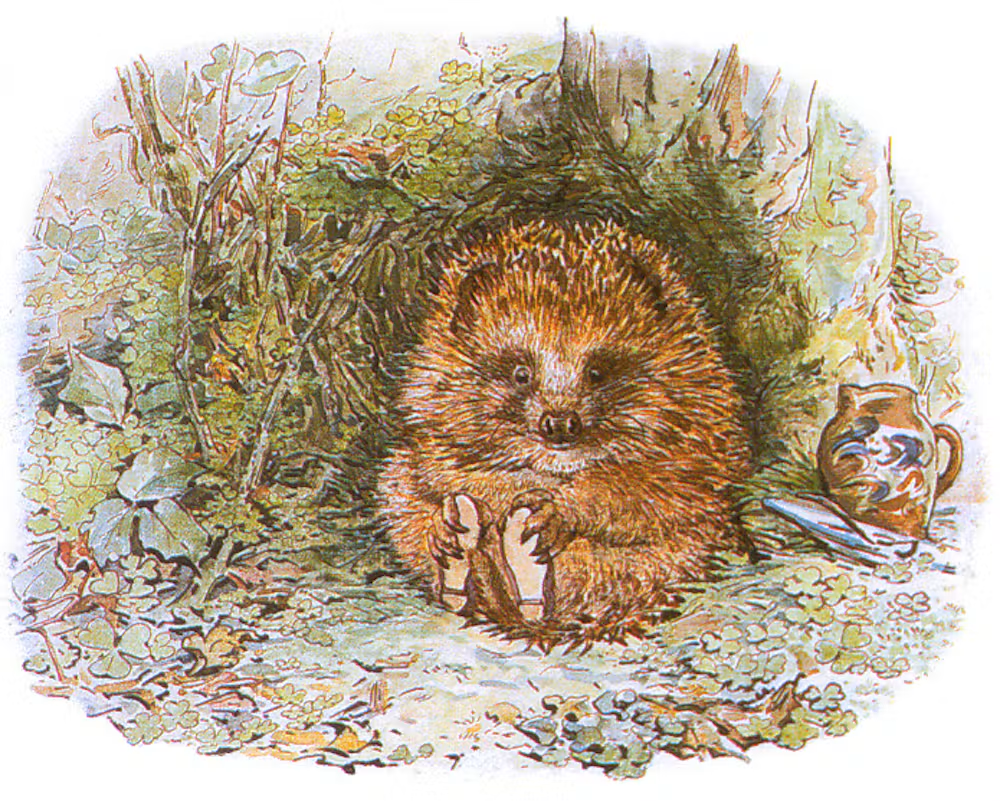
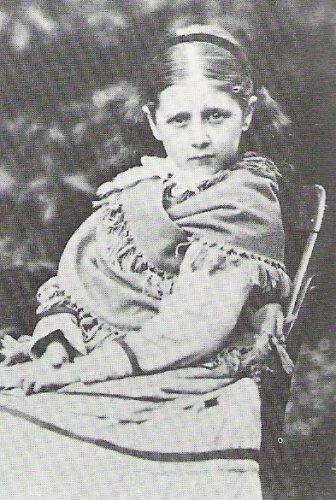
Kingsnorth’s proposal reminded me of Potter, who was the sort of conservative who knew precisely what she wanted to conserve—and how. Potter was born in 1866 in Kensington, London, to Rupert and Helen Potter, joined six years later by a little brother, Walter Bertram. She spent her childhood cultivating a deep love of art and nature. She and Walter populated their home with a menagerie of pets, including rabbits, mice, frogs, lizards, snakes, salamanders, and a rotund hedgehog. Walter even had a pair of long-eared bats that he left with Beatrix when he went to boarding school. She painstakingly painted and sketched them all with astonishing skill.
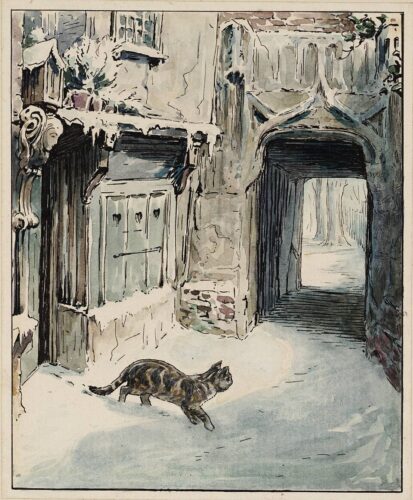
Potter’s pets and artwork turned into tales for children and in 1901 at the age of 36 she self-published the first edition of The Tale of Peter Rabbit after publishers turned her down due to her insistence that the price must be kept low to keep the story affordable for children. The following year, Warne & Co. published an abridged version to an enthusiastic public reception, and several sold out editions. They asked Potter for more, and a series of stories were published in swift succession. There would eventually be 33 in all, and Potter became one of the most famous children’s authors of all time.
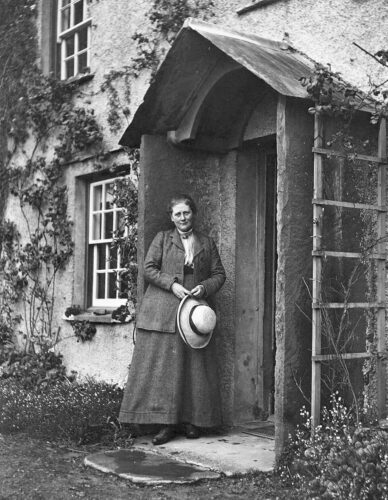
Her success made Potter wealthy, and in 1905 she purchased Hill Top Farm in the Lake District village of Near Sawrey in the north of the country for £2,805. She planted a garden, continued painting and writing, and started farming. Potter took up residence in a beautiful two-story farm cottage built in the 17th century with a pitched roof, two chimneys, and vines creeping up the stone walls. Hill Top Farm, the nearby village, and the surrounding countryside became her haven and her passion. She decided to do everything in her power to protect it, buying adjacent properties from struggling farmers to prevent industrialists from scooping it up and developing it. Her land holdings soon included ancient woodlands, open fells, watersheds, and more than a dozen working farms.
Once an urban girl from London, Potter became a locally renowned farmer and the simplest sort of conservationist—one who sought to conserve the things around her that she loved. As it turned out, that would come to include her adopted way of life. As Oxford professor Keith Thompson put it, Potter “helped save a crucial part of the English countryside”:
The authentic Lakes breed was, and is, the Herdwick Sheep, a cold-hardy animal adapted to graze the harsh uplands. Typically, each farmer has a small piece of his own lowland pasture for overwintering. The rest of the year, his flock grazes on a portion (a “heaf”) of the communal, open-range fells, which are inaccessible except on foot. Each year, new Herdwick lambs learn from their mothers the territories to which they will return the following year. “Heafed” lambs then stay on their territories without supervision—a useful trait unique to the breed. However, Herdwicks produce a coarse wool useful only for carpets. Crossing them with other breeds would have produced finer wool, but the less-hardy offspring would neither fend for themselves nor graze the fells evenly. Bracken fern would take over the grassland, for example. Preserving the tradition of hill farming, based on the Herdwick sheep, required constant attention to breeding and land management. But without this effort, a way of life and an entire landscape would have been lost.
When Potter died at the age of 77 in 1943, she bequeathed 14 farms and 4,000 acres of land valued at between $14 million and $35 million in today’s currency to Britian’s National Trust to ensure that the lands she loved would be permanently preserved. Potter’s former property is now part of the 855-square-mile Lake District National Park, England’s largest.
Obviously, few can afford to engage in this sort of conservation. But Potter’s example highlights the fact that at the most basic level, a conservative should seek to conserve the things he loves that are close, immediate, and local. Everybody wants to save the world, a pundit once joked—but nobody wants to pick up the trash. That applies to social conservatives, as well—activists, politicians, and writers cannot save “the family”—but individually, we can do our best to save our own by pouring our hearts into our spouses and our children and prioritizing hearth and home above all. In a world driven by the engines of social media, the big causes often drown out the little causes—our own villages, town; neighborhoods and families.
Potter didn’t try to save the world. She bought the land surrounding her farm and sought to protect a few local farming traditions—and she succeeded where the utopians of her century collectively failed. “One place suits one person, another place suits another person,” Potter wrote in one of her children’s books. That was all the reason she needed to conserve the place that suited her. “I remember every stone, every tree, the scent of heather,” she wrote later. “Even when the thunder growled in the distance, and the wind swept up the valley in fitful gusts, oh, it was beautiful, home sweet home.” And because of her, it is all still there.