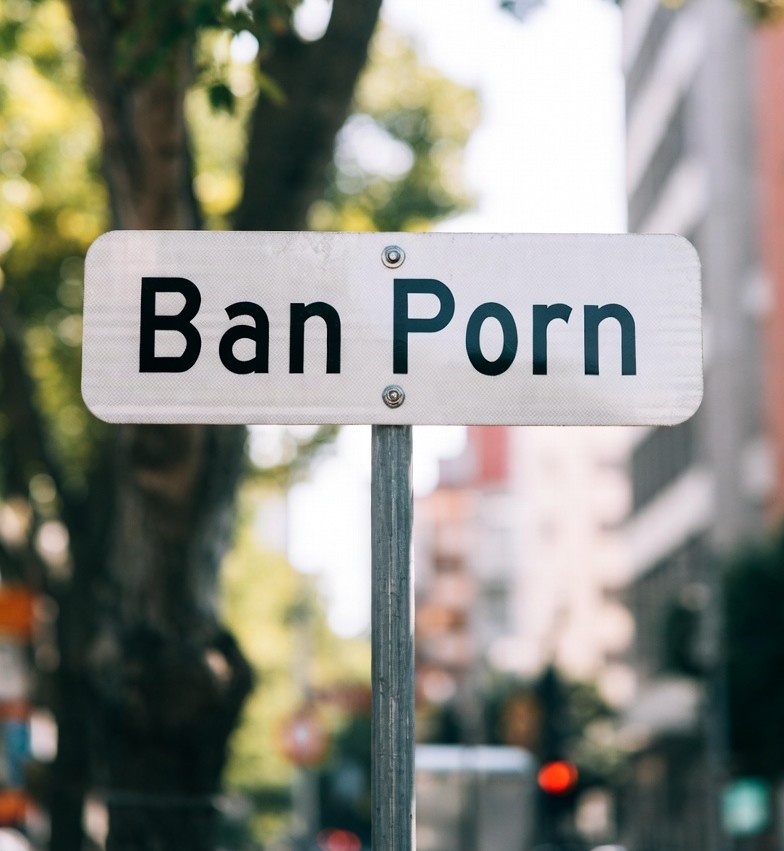
According to the Survey Center on American Life, young men are now more in favor of restrictions than middle-aged men. In 2021, 43 percent of young men and 58 percent of young women between the ages of 18 and 24 thought that access to porn should be restricted. In 2025, that had risen to a staggering 63 percent of young men and 72 percent of young women. Having spent the last 15 years talking to young people about pornography, those numbers do not surprise me.
In the 1970s and ’80s, porn was “cool” – at least Hugh Hefner, smut-peddler and self-proclaimed Playboy philosopher, tried to make it so. He tucked his porn centerfolds between interviews with civil rights leaders and short stories by feminist Margaret Atwood; appeared on talk shows with a pipe and smoking jacket; and made his Playboy Mansion the stuff of lascivious legend. It wasn’t until after he died that the full extent of his vile predation became known.
In the 1990s, the porn industry began to conquer the culture. Restrictions on porn melted away in the face of the internet, which arrived with desktop computers. Porn models exploded off the front covers of slimy magazines to become cultural figures in their own right. Major music stars used porn performers as backup dancers in their videos. Compulsive porn use became a constant punchline in era-defining TV shows such as Friends and Seinfeld. Porn wasn’t just cool – it was normal.
In the 2000s, it all fell apart. The porn industry didn’t just conquer the culture – it conquered our homes. Almost all of them. The internet ensured that every device with a Wi-Fi connection was the equivalent of a bottomless closet filled with the most depraved forms of pornography the human imagination could conjure – and the closets were unlocked. Millions of children, adolescents, and teens opened the doors and spent years inside. Porn addiction was rampant at the high school I attended. It probably was at yours, too.
Those who grew up with computers at home were often exposed to porn. Those who were handed smartphones, which first arrived in 2007, almost all did. Childhood exposure to pornography ended up defining the growing up years for countless young people, and they carried the scars and the struggles into their relationships, their careers, and their lives. The social costs of pornography have been staggering, and over the past 10 years, more people are willing to say so out loud. Gen Z grew up with pornography everywhere.
“Neel Dhar was 7 years old when he first clicked on an online ad that led to pornography,” Mariya Manzhos wrote in a recent report by Deseret titled “Gen Z grew up with pornography. Now they’re leading the charge against it.” “Even though he didn’t understand what he saw, his curiosity took him down a rabbit hole of the internet and its darker corners. Over time, he found himself spending more and more hours there. ‘The only thing I wanted was hard dopamine and nothing else,’ he said.” I have heard similar stories more times than I can count. For millions of children, pornography was their first exposure to sex.
“Dhar, who is now 19 and lives in San Diego, is part of a generation that grew up with the internet, and pornography, in their back pockets,” Manzhos writes. “Much of what Dhar and his peers learned about intimacy and relationships during his high school years came from the sexualized content he encountered online … But it’s also the digital natives of Gen Z – who encountered pornography before they knew what it was – who are at the forefront of fighting it.” Dhar decided to quit porn.
“Relay, the app that Dhar joined, was started by 27-year-old Chandler Rogers, who similarly struggled with a pornography habit and wanted to help men combat the addictive patterns,” Mazhos notes. Rogers isn’t the only one. “Earlier this year, Joshua Haskell, a 23-year-old graduate of the University of Notre Dame, founded Ethos National that also focuses on accountability and is based on Catholic teachings.” Other major apps include Covenant Eyes and Matt Fradd’s Strive 21 program, a 21-day porn detox.
Gen Z’s biggest stars hate pornography, too. Theo Von, the popular comedian and podcaster, has talked about his struggle with porn over a dozen times at length, from describing his exposure to porn to fighting the addiction and its impact on relationships. Rock star Billie Eilish has said pornography “destroyed my brain” after she first got addicted at age 11. Comedian Nikki Glaser opened up about her own porn addiction to Joe Rogan in graphic and despairing terms. Even the comedians no longer find porn a joke.
Gen Z doesn’t hate porn because they are prudish. They hate porn because they were exposed to it from a young age and it shaped their lives in ways completely beyond their control. I have heard their stories, hundreds of them, over the past decade and a half. The story is always the same: Porn did not bring liberation. Porn brought, and brings, despair. The porn industry is no longer viewed as cool; it is seen as the enemy. It always was. But now, most people know it – and the young have learned by bitter experience.
Perhaps they will do what the adults refused to do, for decades: ban this poison, and begin to build a better world.