American Politics
The Comeback of Patrick Buchanan
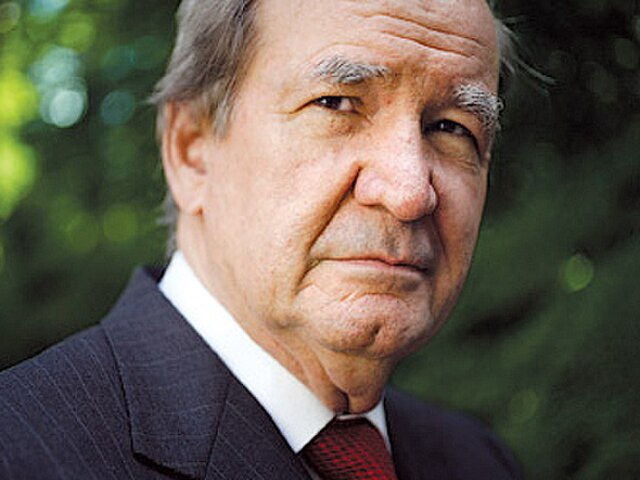
Patrick Buchanan is having something of a moment. The 87-year-old author, erstwhile presidential candidate, and veteran of the Nixon, Ford, and Reagan administrations, has been credited as a key influence behind the MAGA movement’s rejection of foreign interventionism and embrace of trade protectionism and anti-immigration policies. Commentators from Matt Walsh to Chad Pecknold have praised him effusively as essentially right about everything.
Buchanan, who founded The American Conservative magazine in 2002, has an impressive track record. He was a popularizer of paleo-conservatism as well as the phrase “culture war,” in his famous declaration at the 1992 Republican National Convention: “There is a religious war going on in this country. It is a cultural war, as critical to the kind of nation we shall be as the Cold War itself, for this war is for the soul of America.” He was right then, and he saw what was coming before many others did.
I have many of Buchanan’s books and have written for The American Conservative. But I cannot help but notice that many of the grand old man’s online fans are most enthusiastic about his worst book, Churchill, Hitler, and “The Unnecessary War”: How Britain Lost Its Empire and the West Lost the World (2008). Buchanan took aim at Churchill, insisted that Great Britain and the US should have stayed out of World War II, and suggested that historians had conspired to hide the truth about the war.
In a formal debate on the central thesis of the book with historians Andrew Roberts and Antony Beevor, Buchanan was decisively embarrassed, and those interested in this newly popular interpretation of World War II—one of Tucker Carlson’s latest hobby horses—would be well served by watching it. Buchanan’s central claims fall apart spectacularly.
Synonymous with Buchanan’s rise in popularity has been the villainization of the late William F. Buckley, the founder of National Review, host of Firing Line, and one of American conservatism’s premier coalition-builders. Podcaster Dave Smith recently referred to him as “one of the great villains of the 20th century,” with Tucker Carlson bursting into a characteristic bout of maniacal laughter and bellowing: “I couldn’t agree more!”
Buckley, like Buchanan, was a social conservative; he was also an anti-Communist Cold warrior who forged alliances with neoconservatives and other ideological factions. His gatekeeping of the movement and purging of antisemites and conspiratorial crackpots has come in for fierce criticism by those who are, more often than not, personally offended by this and perhaps rightfully feel that Buckley would have seen through them.
In 1992, Buckley published In Search of Anti-Semitism, in which he criticized statements made by Joe Sobran (who had, among other things, questioned the historiography of the Holocaust) and a column by Buchanan in which he cherry-picked the names of Jewish supporters of Operation Desert Storm and noted unsubtly that their preferred policies would send “kids with names like McAllister, Murphy, Gonzales, and Leroy Brown” to die. In fact, Jewish Americans served in the Gulf War in numbers roughly proportional to the Jewish share of the American population at the time. Buckley noted that he believed Buchanan himself was an iconoclast rather than an antisemite.
I was disappointed to find that Sam Tannenhaus’s recent biography, Buckley, devotes almost no space to this incident. In fact, it appears as if Tannenhaus simply ran out of time to complete it by the Buckley centenary last year—by page 800 he’s only into 1980—and decided to run with what he had. There’s plenty of stuff on the Birchers, but not much on the antisemitism debate, which now rages with renewed vigor.
Buckley’s gate-keeping—and his balanced critique of Buchanan—have made him a posthumous target. But there is a catch-22 for Buckley’s critics. Buchanan has been hailed of late by the vilest figures of the Jew-hating Online Right: Nick Fuentes, Holocaust-denier and Hitler apologist Jake Shields, revisionist history podcaster Darryl Cooper, and Richard Spencer, among dozens of other large influencer accounts. Their very embrace of Buchanan, however, validates Buckley’s original critique.
Ironically, the online Jew-haters embracing Buchanan are reading him precisely the same way Buckley did. So, either the Groypers are slandering Buchanan by embracing him as one of their own, or Buckley was dead right. Take your pick.
Buckley, of course, stated that while Buchanan’s rhetoric was “contextually antisemitic”—implying that Jewish warlords were sending American working class boys to die in wars—Buchanan himself was not. Many of Buchanan’s belated followers do not deserve such evenhanded treatment. He may have been iconoclastic, but he referred to Nazism as a “murderous ideology.” I suspect that Buchanan would loathe most of his current fans.
The current civil war on the American Right proves that few genuinely have a problem with Buckley’s gatekeeping. The debate isn’t so much about whether the movement should have borders, but about who is outside them. Those currently claiming that ideological borders constitute “cancel culture” are merely using that argument as a way of admitting ideological factions previously considered beyond the pale. And if Nick Fuentes is leading the Buchananite army, we’re going to miss Buckley more than we thought.
Related Posts from The Bridgehead: