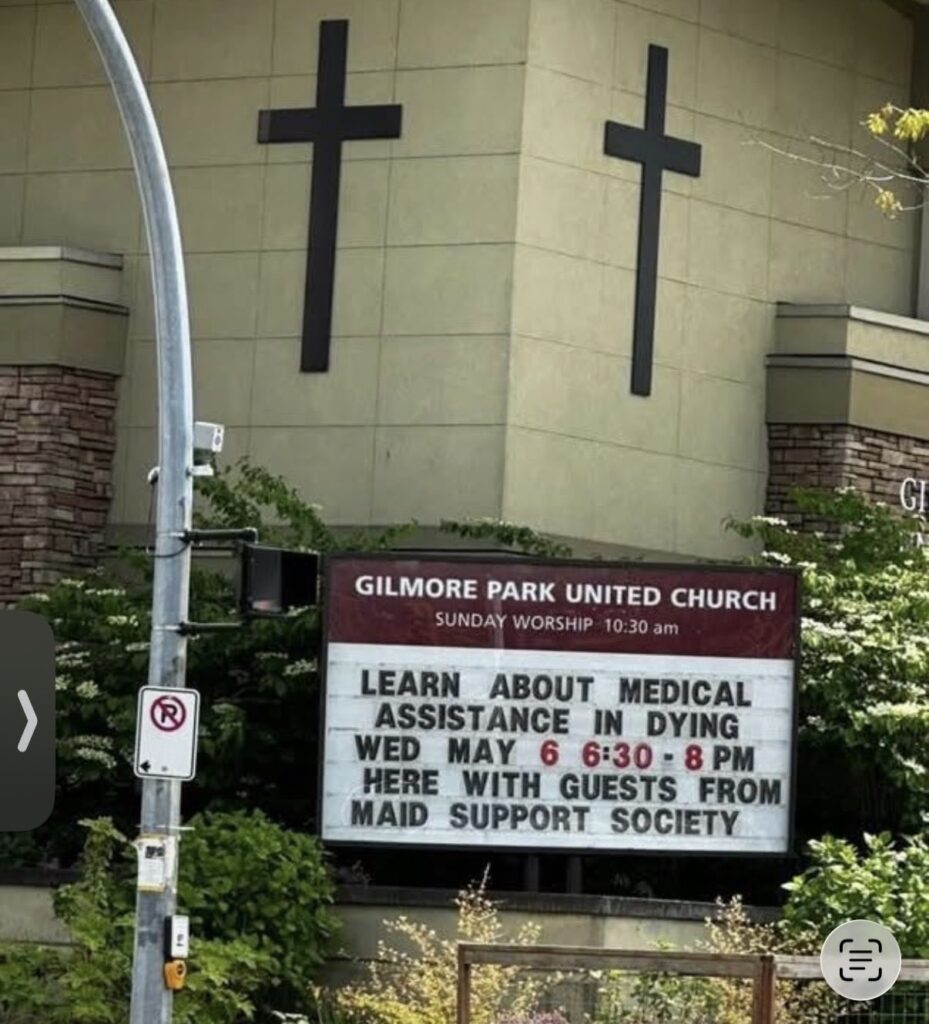
The moral implosion of Canada’s mainline Protestant denominations began decades ago, but Adam Smith’s observation that “there is a great deal of ruin in a nation” is also true of post-Christian churches. Last month, a United Church in Richmond, British Columbia, was spotted advertising a seminar on “medical assistance in dying.”
The United Church has been dying for years, and in its terminal condition appears to have given up hope to such an extent that it endorses euthanasia – a survey nearly 15 years ago found that the median age of its members was 65. That will only have gone up since then. Generally speaking, the United Church believes in nothing; as a rule, what it does believe is morally abhorrent.
The Anglican Church of Canada is now attempting to outdo its collapsing counterparts. In a 66-page document released this month titled “Pastoral Liturgies at the Time of Death in Contexts of Medically Assisted Dying,” the Council of General Synod authorized the “trial use” of liturgies for those about to be killed by euthanasia, including “prayers to be read immediately before the fatal drugs are administered, as well as prayers after the patient’s death.”
The document states that while many Anglicans are strongly morally opposed to euthanasia, others “have had profound experiences in which a death by MAiD has been accompanied by faithful prayer and strong pastoral care.” Despite the attempted sidestep of the moral question, the document expresses clear tacit moral approval of euthanasia. This paragraph, for example, could have been written by Dying with Dignity:
People who choose MAiD freely and without coercion may indeed be ready to go. They have been living with and suffering through complex health challenges and they want the pain to stop. They want to be able to sleep. They desperately do not want their families and loved ones to watch and wait, wondering how much longer? They have exhausted all medical options, and they know, everyone knows, that there is no cure. Some wish, most of all, not to be alone at the time of their death, and to die well. Some, who are Christian, also desire not to be alone at the time of their death, and to die well, and with the grace and blessing of God and with the presence of the Church at their side.
The Synod then provides and details a series of religious rites, tailor-made for euthanasia. These rites include final confession, absolution, anointing with oil, receiving the Eucharist, blessings, and laying on of hands, and prayers. For those considering euthanasia, it is difficult to interpret this document as anything other than formal church sanction of death by doctor-administered lethal injection.
One suggested prayer for just before the killing of the patient reads as follows:
We gather today in a space that may be foreign to us. There are sounds, lights, and activity outside of this room that can distract and take us away from this space. But God meets us here, in this time and place, a thin-space that is sacred. We gather as friends and family (and health care professionals) with our hopes, our dreams, and our differences. While some of us may not always agree with the choices of others, we are united in our common love and compassion for N. May we know the presence of God as we pray together.
After the prayer is completed, the Synod suggests a time of “quiet reflection”:
What follows is a time of silence and quiet reflection. The medical team may enter soon for their role at this point. Family and those gathered who wish to share last thoughts or conversation with the dying can do so now, or before the liturgy begins. Anyone who does not wish to be in the room during the medical procedures may go to a space prepared for them.
Notice the language here. The medical team may enter for “their role” or “the medical procedures” – killing the patient. The patient, incidentally, may not actually be “dying” at all, as Canada has removed the “reasonably foreseeable death” eligibility requirement for euthanasia. A post-mortem prayer suggested by the Synod emphasizes that the deceased has now been “freed from all cares,” and another states that those gathered together offered “their final gift” to “see (Name) safely home.”
For the Anglican Synod, it seems, the act of suicide-by-doctor – a final and defiant rejection of God’s power over life and death – is of no real moral relevance to the individual. The Synod attempts to sidestep the issue of whether euthanasia is morally wrong, stating that regardless of the circumstances, “there is a duty of pastoral care.” But what about the duty to give moral guidance? The new death liturgies make it clear: Cooperation with Canada’s euthanasia regime is Anglican policy. This is not simply moral failure – it is moral suicide.