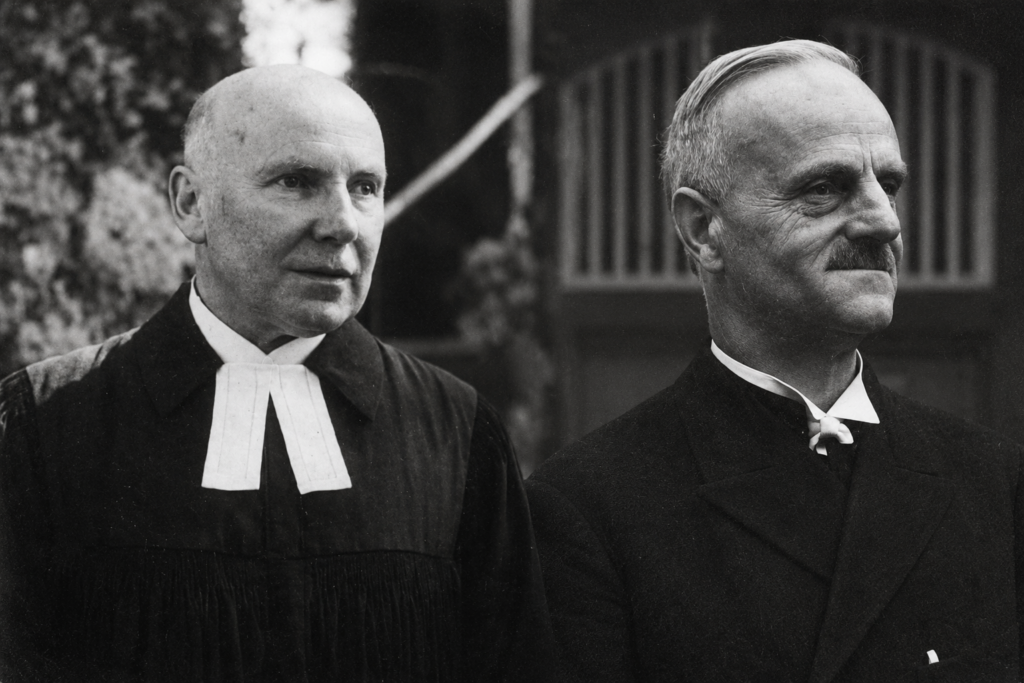
Paul Braune watched calmly as the police ransacked his rectory office in Lubetal, Germany. Arrested by SS chief Reinhard Heydrich himself on August 12, 1941, Braune was accused of having “sabotaged measures of the regime and the Party in an irresponsible manner.” Officers rifled through his papers—from the German Confessing Church and the Association of Asylums, among others—but the object of their search eluded them.
Eventually Braune removed some papers from his desk and handed them to the officer in charge. “Well, Gentleman, this is the document that [the] Gestapo is interested in,” he said. The officer began to read the papers intently. “But this cannot be possible!” he said, stunned. The document revealed evidence of the Nazi T4 euthanasia program—the mass killing of people with disabilities and other “defects” and conditions. Even many high-ranking Nazis were unaware of the program.
Braune was led from his office and taken to Berlin, where he was placed in “protective custody” at the notorious Prinz-Albrecht-Strasse prison in Berlin where he remained for ten weeks.
***
Paul Gerhard Braune was born in 1887 and, by age 15, knew he wanted to be a clergyman. He began his theological studies in 1906 and spent one term at Bethel in Bielefeld, a world-renowned Protestant institution for people with disabilities run by Friedrich von Bodelschwingh. His experience there made a profound impression on Braune, but after serving a year as a Berlin military chaplain (1912-13), he took up the pastorate of three parishes in Hohenkränig.
In 1922, von Bodelschwingh asked Braune to take on the role of director of the Hoffnungstal Institute for the handicapped in Lobetal. He accepted and from May 1922 until his death in 1954 worked tirelessly as rector and director of the Institution. When he first began his pastoral work with people with disabilities, neither Braune nor his mentor von Bodelschwingh had any idea that their task would involve not just caring for their patients but protecting them from a government determined to eliminate all those they viewed as “useless eaters” and “unworthy of life.”
Adolf Hitler was appointed Chancellor of Germany in 1933; just two years later, he began to plan for the elimination of those with disabilities, mental illness, and other conditions. Propaganda films framing them as burdens on society were produced: The Inheritance in 1935, and Victims of the Past in 1937. Hitler knew that mass mercy-killing would provoke a backlash, and so he planned to launch the murder of “life unworthy of life” when the inevitable war began. In the interim, preparations, including surveys of patients in psychiatric hospitals, were begun.
Hitler signed the official written authorization for the “mercy-killing” program—dubbed “Aktion T4 ”—in October 1939, but it was backdated to September 1 to link it to the outbreak of World War II. Months previously, in August, the Reich Ministry of the Interior had distributed a decree requiring that all newborns and children under the age of three who showed signs of physical or mental disability be reported. Hitler placed the program under the direction of his personal physician, Karl Brandt, and Philipp Bühler, Chief of his Chancellery.
Braune first learned of the program in late 1939 at a meeting of fellow clergy, who told him that “invalids” were “being picked up from sanatoriums, transferred to unknown locations, and never seen again.” Soon after this grim revelation, Braune got a missive from the Reich Health Ministry ordering him to give up children in his care for “Sonderbehandlung” (special treatment). He now knew what that meant.
READ THE REST OF THIS STORY AT CANADIAN PHYSICIANS FOR LIFE