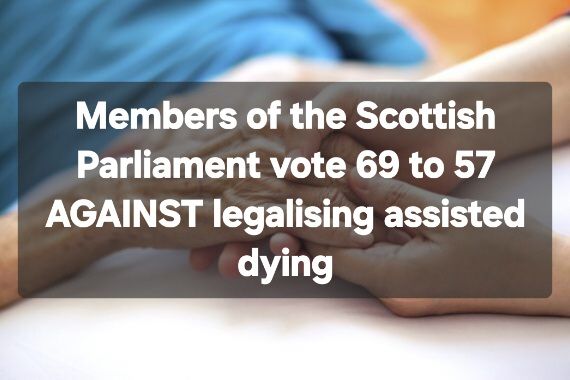
The MSP who sponsored Scotland’s assisted suicide bill has said that he will not reintroduce the legislation in the next parliament after the “Assisted Dying for Terminally Ill Adults Bill” failed last Monday in by a margin of 69 votes to 57.
Liam McArthur, a Liberal Democrat, had pulled out all the stops in the days leading up to the vote, accepting over 150 amendments to persuade MSPs to switch sides and support the bill.
“McArthur was visibly emotional after the defeat and shared embraces with colleagues as the Holyrood chamber emptied,” the BBC reported. “He said that Holyrood’s failure to pass the new law was a ‘woefully inadequate’ response to the suffering and trauma experienced by dying Scots. After five years of work on the proposal, he said it was time to pass the baton to someone else after May’s Holyrood election.”
McArthur’s demoralization is understandable; the defeat of his suicide bill is a stunning setback for U.K. suicide campaigners and will likely stiffen the resolve of opponents of Labour MP Kim Leadbeater’s suicide bill in the House of Lords. Lord Charlie Falconer, the bill’s sponsor in the Upper House, has been angrily insisting that opponents of the bill are acting in bad faith by requiring amendments and safeguards. That tactic just failed spectacularly in Scotland – and for good reasons.
For decades, suicide campaigners have relentlessly hammered the public with morbid stories of excruciating deaths, insisting that the state must legalize and facilitate assisted suicide or euthanasia or be found directly responsible for this suffering. These storytelling campaigns have been tremendously effective, especially as secularization has eroded moral opposition to suicide, leaving only squeamishness or personal discomfort in its wake. But with assisted suicide or euthanasia legalized in a number of Western countries, those fighting the Culture of Death have stories of their own.
As the Spectatornoted in its autopsy of Scotland’s assisted suicide law: “In the Netherlands, the first country to introduce euthanasia two decades ago, similar safeguards were applied. They didn’t stick. Now people with mental health problems are granted elective euthanasia. Even healthy young women such as Zoraya ter Beek, 29, have been given the freedom to end their lives – in her case because of depression and against the pleas of her family.” Every year now produces scores of similar horror stories.
McArthur insists that the next attempt to push a suicide bill through in Scotland will succeed, even if he is not spearheading the charge. “I’m fairly confident as a result of what we saw last night that the next attempt to get this over the line will be successful and probably fairly comfortably so,” he told the Around Orkney program. “This issue is not going away, the number of people affected by these bad deaths – given the demographic trends, given the advances in medicine – those numbers are only going to increase, and meantime the overwhelming majority of people across Scotland are supportive of a change.”
He may be right about that. Majorities do support assisted suicide in principle. What has changed – not only in Scotland, but also in Slovenia, where voters overturned their government’s assisted suicide bill in November despite supporting assisted suicide in theory – is that other countries have revealed what inevitably expanding euthanasia regimes look like in practice. Dying in Dignity Scotland pushed polls insisting that support for the bill was close to 80 percent; a poll by Not Dead Yet UK, however, found that 69 percent believed that legislators should first “prioritise access to care for disabled people.”
As is so often the case, polls are usually commissioned to shape public opinion, not to gauge it. In Scotland, suicide campaigners faced stiff opposition from medical bodies of every stripe, disability rights groups, and many high-profile politicians. Scotland was proof that suicide campaigners can lose – and more importantly, that defenders of the vulnerable can win.