Early on the morning of September 11, 2001, Danny Lewin kissed his wife Anne and their two sons, 5-year-old Eitan and 8-year-old Itamar and headed to Boston’s Logan Airport for a business meeting in Los Angeles. On board American Airlines Flight 11 were 81 passengers, two pilots, and nine crewmembers. It never reached LA. At 8:46, the plane slammed into the side of the North Tower of the World Trade Center, killing everyone on board—except for Danny Lewin. He was already dead.
The truth about the 31-year-old Internet entrepreneur’s death emerged several years later. Lewin was an American Israeli dual citizen and a veteran of one of Israel’s most elite counterterrorism units. According to dozens of interviews with those who spoke to the flight attendants on the ill-fated Boeing 747, Lewin got out of his seat and attempted to stop the hijacking by attacking one of the terrorists. During the struggle, Saudi hijacker Satam al-Suqami slashed his throat from behind.
Lewin was likely dead before the first report of the hijacking reached American Airlines at 8:19 a.m. “The cockpit is not answering, somebody’s stabbed in business class—and I think there’s Mace—that we can’t breathe—I don’t know, I think we’re getting hijacked,” flight attendant Betty Ann Ong reported calmly via airphone. Lewin was the passenger Ong was referring to; he died between 8:15 a.m. and 8:20 a.m. On a black day full of horror and heroism, Danny Lewin was both a thwarted hero and the first victim of the 9/11 attacks.
***
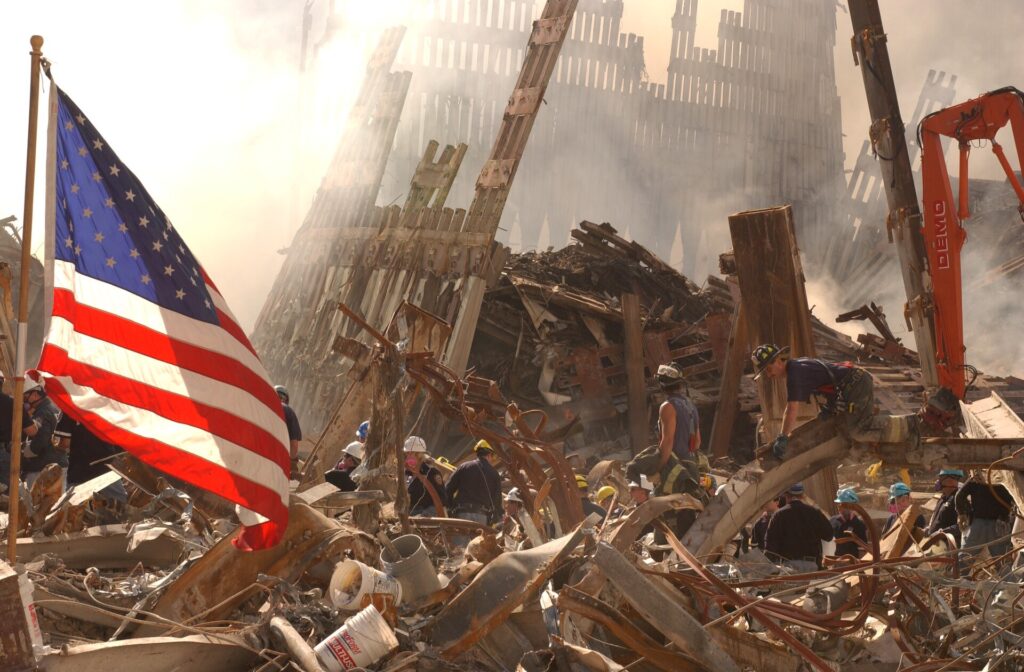
I’ve only visited New York City a handful of times. A few years after 9/11, I went to see Ground Zero, two gaping holes in the ground still under construction, street vendors clustered around the site selling photos and other memorabilia. Like everyone else peering into the pits, shaking their heads, I remembered 9/11 as the foundational historic event of my youth. Our holiday from history began when the Berlin Wall fell; it ended with planes filled with people flying into towers filled with people. Like everyone else who watched it unfold, my most vivid memories are of those who jumped.
Earlier this year at the 9/11 Memorial & Museum, I saw the photos again in an alcove exhibit about the jumpers. Between 50 and 200 people jumped or fell from the towers as the buildings burned. There is a quote from James Gilroy, a resident of Lower Manhattan, on the wall. “She had a business suit on, her hair was all askew…This woman stood there for what seemed like minutes. Then she held down her skirt and then stepped off the ledge…I thought, how human, how modest, to hold down her skirt before she jumped…I couldn’t look anymore.”
Another quote, this one from Louisa Griffith-Jones: “You felt compelled to watch out of respect to them. They were ending their life without a choice and to turn away from them would have been wrong.”
Writer Peggy Noonan, who became the premier chronicler of 9/11 and its aftermath in New York City, recalled in her tenth anniversary column that only time unlocked some horrors. “My friends saw the jumpers, who fled the flames,” she wrote. “To this day they don’t talk about it. My friend saw the faces of the passengers on the first plane, so low did they fly by his building. He saw their faces in the passenger windows. He never told anyone about that, including his wife, until two years ago.”
***
I reread Peggy Noonan’s post-9/11 column collection A Heart, A Cross and A Flag earlier this year, and it is as powerful as I remembered. What I found most poignant about her columns, however, is her optimism that a new America might rise from the ashes of the Twin Towers—an America that sought to recover the best of her former self and to return to God. On September 28, she wrote in the Wall Street Journal that “God is Back.”
“He’s bursting out all over,” Noonan reflected. “It’s a beautiful thing to see.”
The displays at the 9/11 Museum provide evidence for her optimism. Amidst the twisted girders of the towers, the mangled rescue vehicles, the “Survivors’ Staircase” and photographs of abandoned, ash-covered baby strollers, is the massive steel crossbeam known as “The Cross At Ground Zero,” uncovered in the rubble on September 13. It became an on-site shrine and a place of prayer for the beleaguered workers, and was placed in the museum against the protests of groups like the American Atheists. Chaplain Steve Lee wrote a poem on the 17-foot cross:
From God’s House –
Fired new from dying flame,
this living sign remains,
arms outstretched, embracing yet,
our avalanche of pain,
to still, to fill –
to heal again
In St. Paul’s Chapel, which miraculously survived the collapse of the towers, stands another cross. St. Paul’s opened in 1766; George Washington worshipped there. Workers from Ground Zero found refuge in the church, sleeping off their exhaustion in the pews, eating, receiving medical care. The Iron Memorial Cross, forged from the rubble of the World Trade Center by blacksmiths, was gifted to St. Paul’s in gratitude for the spiritual and physical care the workers received there. It stands next to the “Cup of Life,” a communion chalice created from salvaged WTC steel.
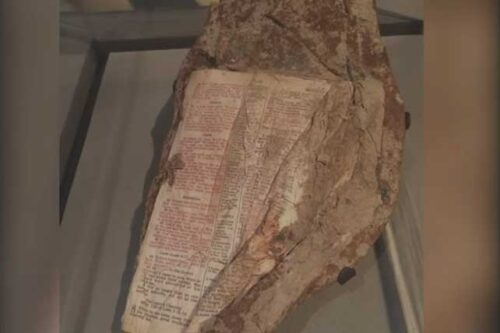
The Christian stories are everywhere in the 9/11 Museum. Most powerful is the Ground Zero Bible, a piece of a King James Bible recovered from the wreckage of the South Tower by a firefighter. The pages were fused to the steel under intense heat and the pressure of the collapse; one page remains exposed on a heart-shaped fragment. It is a passage from the Sermon on the Mount in Matthew 5: “Ye have heard that it hath been said, An eye for an eye, and a tooth for a tooth: But I say unto you, That ye resist not evil: but whosoever shall smite thee on thy right cheek, turn to him the other also.”
But September 11 did not usher in a new Christian century. The decades that followed have only deepened the religious divide; Christianity in America is far from dead, but the revival many hoped for never arrived. Noonan’s column on October 12, on the return of masculinity as demonstrated by the heroic firelighters, cops, and rescue workers, also seems desperately hopeful in retrospect. America is convulsing with a crisis of masculinity. The post-9/11 unity, squandered in the years and wars that followed, was the high-water mark of American patriotism, not its rebirth.
Instead, our digitally driven divide has turned even 9/11 itself into a culture war battlefield. Many of the biggest influencers on the American Right, from Tucker Carlson to Candace Owens, have joined the most unstable elements of the Left in claiming—explicitly or implicitly—that the worst terrorist attack on American soil was perpetrated by the American and Israeli governments. Danny Lewin’s death on board American Airlines 11 goes unmentioned. The first victim of 9/11 is an inconvenience for conspiracists, because he was both Israeli and American.
If 9/11 happened today, we wouldn’t get Peggy Noonan columns. We would get raving bile from conspiracy mongers.
***
In the museum gift shop, I picked up 102 Minutes: The Untold Story of the Fight to Survive Inside the Twin Towers, and could not put it down. At about 8:40 AM, 25-year-old Patricia Massari of Queens, a capital analyst at Marsh & McLennan on the 98th floor of the North Tower, called her husband Louis to tell him that she’d bought a second pregnancy test. She’d taken one that morning, and it had been positive, but she wasn’t sure. They’d wept tears of joy. Louis was already looking forward to being a father.
They talked for just a few minutes when Patricia uttered an exclamation and a prayer: “Oh, my God!” and the line went dead. American Airlines 11 struck the North Tower between floors 93 and 99 at roughly 450 miles per hour carrying thousands of gallons of jet fuel. Nobody on or above the 92nd floor survived. The book did not say if she had confirmed her pregnancy to her husband, but I found her name on the 9/11 Memorial outside. It reads: “Patricia Ann Cimaroli Massari and her unborn child.” That day, Louis discovered that his family had grown to three; then, in a moment, there was only one.
As I walked around the memorial, I found the names of ten more mothers followed by the inscription: “and her unborn child.” At the very heart of America’s abortion capital, where tens of thousands of unborn children are killed in clinics and hospitals each year because the state formally rejects their status as children, 11 unborn babies are recorded and remembered as someones. Their loss meant something, and the 9/11 Memorial records that fact—as well as their humanity—in bronze. That is not nothing.
***
In the museum, people were remembering. Some looked at displays, tears threading down their cheeks. A young man was searching for someone on the Wall of Faces, filled with photographs of the 2,983 victims of 9/11. His face was drenched. His friends didn’t seem to know what to do. A sturdy young father was holding his little daughter’s hand. She was wearing a red dress. He was choked up, swallowing rapidly, and kept checking to see that she was okay. She was. When he picked her up and held her close in front of the Pentagon display, she seemed to understand it was for his own comfort and let him hug her tightly, her face dry-eyed and serious.
I caught snatches of conversation as we walked through the museum. “I was at school.” “I was teaching.” “I remember I was just…” In the theatre, a tour guide named Vinny Maida was on the verge of tears as he introduced a short documentary on the massive 9/11 boatlift, which rescued half a million people from Manhattan Island in an evacuation larger than Dunkirk. He thanked us profusely for being there. He lost a cousin and two close friends on 9/11, he said. One was in the North Tower at the point of impact. “He was just vaporized.” I tracked Vinny down after the film ended and asked him about them.
His cousin’s name was Kenneth Watson, a 39-year-old firefighter from Engine 214 who died when the South Tower collapsed as he was heading up. His friend John “Jack” Andreacchio, age 52, worked in HR at the Fuji Bank in the South Tower and helped his colleagues evacuate, staying to assist others. He had previously survived the 1993 World Trade Center Bombing while working in the complex. His body was later recovered from a stairwell. His friend Richard Catarelli, who worked for Marsh & McLennan in the North Tower, died when American Airlines Flight 11 made impact with 91 people and Danny Lewin’s body on board.
I asked him what it was like for him to work here. “It’s something,” Vinny said after a pause. “It affects you every day. I cannot pretend it doesn’t affect me when I go home.” Richard’s daughter lives in the basement apartment of his home. He still sees her every day. “After I see her, before my wife comes home, I go up into our guest room, and I cry every day—because I come here, and I see this as it occurred the moment it happened. I saw this happen live. I saw this happen.”
I asked him if there was anything else he wanted to share. “Yes,” Vinny replied. “Laughter lasts only as long as it lasts, but tragedy stays with you forever.” Suddenly, he gave me a hug, and left me with that.