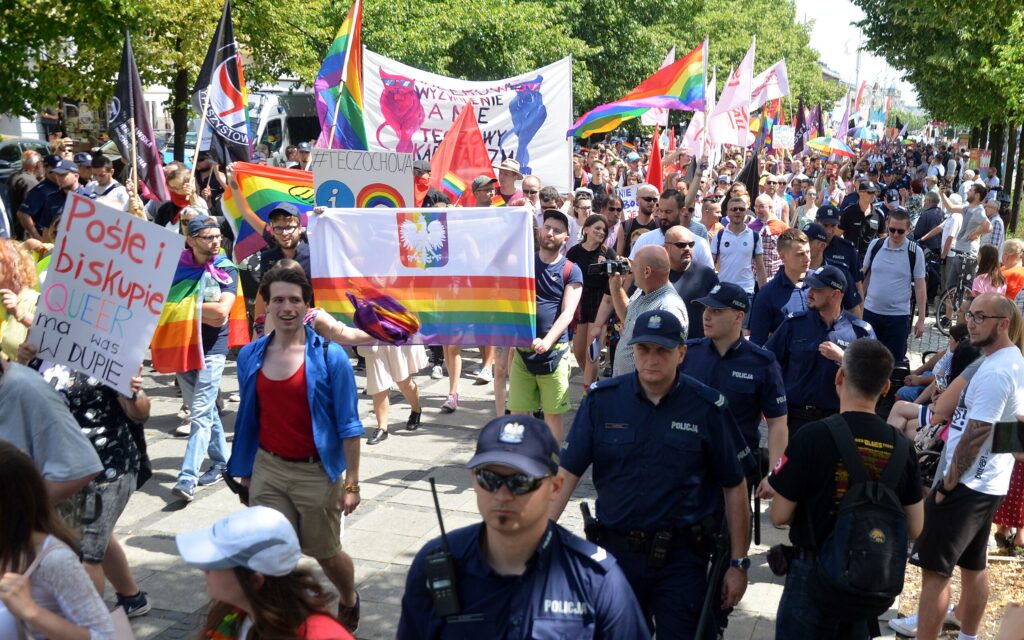
Just before the Polish presidential debate on April 11, Karol Nawrocki placed a Polish flag on his lectern. “I will represent it,” he said. Then, he walked across the stage to his liberal opponent Rafał Trzaskowski’s podium and set an LGBT flag in front of him. “I also have for Mr. Rafal Trzaskowski [The LGBT flag] because he has been running away from this symbolism,” he added, as Trzaskowski swiftly stashed the flag out of sight.
The moment went viral immediately because Nawrocki had, in a single, brilliant gesture, highlighted a primary source of power in Europe: the LGBT movement. Trzaskowski, as mayor of Warsaw, had marched at the head of the Pride parade, pushed for the use of transgender “preferred pronouns,” and, most significantly, directed staff to treat same-sex couples as if they were married. Warsaw was the first Polish city to do so.
Nawrocki’s stunt would have worked almost anywhere in Europe. Nations still clinging to their own cultures, religious heritages, and traditions face relentless campaigns from Europe’s most powerful institutions to bend the knee to the rainbow flag or face the fire. National elections mean nothing to the continental establishment. Nawrocki won the Polish presidency on June 1, and so the LGBT elites promptly employed a different strategy.
On November 25, the European Court of Justice ruled that Poland must recognize same-sex marriages conducted in other EU member states. The ruling takes direct aim at Article 18 of Poland’s constitution, which states that “Marriage, being a union of a man and a woman, as well as the family, motherhood, and parenthood, shall be placed under the protection and care of the Republic of Poland.”
The case started when a homosexual Polish couple got married in Berlin and requested the transcription of their marriage certificate into Poland’s civil registry. This was denied because Polish law does not recognize same-sex marriage. The couple sued. The Civic Coalition Party government’s response came out of both sides of their mouths. Prime Minister Donald Tusk and Interior Minister Marcin Kierwiński assured the public that the EU could not dictate Polish law and that constitutional processes would be respected.
Tusk, who has been waging an extralegal war on Poland’s conservative laws since taking office, added that “respecting tribunals” is also fundamental, while Interior Minister Marcin Kierwiński suggested that in order to implement the EU ruling, “we will have to adopt our own legislation.” In other words, the liberal government will likely adopt the tactics of their presidential candidate Rafał Trzaskowski, who advocates same-sex civil unions as a “logical first step.” Towards what? To ask the question is to answer it.
Many Polish conservatives recognized that the EU ruling is a foot jammed in the door, directly undermining the Polish constitution by stating that the recognition of same-sex marriages conducted outside the country is essential for “the fundamental right to respect for private and family life.” President Karol Nawrocki released a scathing response; Adam Andruszkiewicz, the deputy head of the presidential chancellery, called it “an attempt to circumvent the Polish Constitution” and affirmed that Nawrocki “will not submit to the terror of ‘rainbow rulings.’”
It isn’t just Poland. When Bulgaria passed a law banning LGBT propaganda in schools last year, LGBT activists claimed it violated EU law, the UN Human Rights Office called on the government to reconsider, and after President Ruman Radev declined to veto it, called on the European Commission to “step in and hold Bulgaria accountable.” When Hungary passed a similar law in 2021, then-Dutch prime minister Mark Rutte stated that the EU would “bring Hungary to its knees” in response.