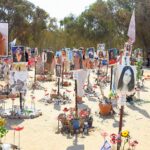
When a missile warning first sounded in his home in Kibbutz Be’eri during the early morning hours of October 7, 2023, Eli Sharabi was not particularly concerned. Rocket fire was relatively common in southern Israel. He sat down with his wife Lianne and daughters Noiya (16) and Yahel (13) in their safe room and turned on the TV, ducking out to make them tea. Terrorists in Toyotas appeared on the screen. Soon, panicked WhatsApp messages began to arrive. Somebody shot Dad! Somebody shot Mom! Our house is burning!
Hamas terrorists flooded onto the kibbutz. Lianne and the girls were British citizens; Sharabi hoped that this might save them. When the butchers smashed into their home, they hastily produced the documents. The terrorists took Eli and left his family behind; as he was dragged away, the homes of their friends and neighbors burning around them, he shouted, “I’ll come back!”
Eli Sharabi would spend the next 491 days as a hostage of Hamas. When he was finally released, he would discover that his wife and daughters had been shot and his house burned just minutes after he was abducted. Last year, his memoir—the first penned by a hostage—was published in Hebrew and became the fastest-selling book in Israeli history. The English translation of Hostage also shot to the top of the bestseller lists.
On January 20, Sharabi spoke in Toronto at an event put on by Chabad on Bayview. Despite Arctic temperatures, long lines, and heavy security, two thousand people packed the venue to hear him tell his story. The event was opened by a rabbi offering a prayer for the IDF and a recitation in Hebrew of Psalm 121; media commentator Ben Mulroney served as MC.
The memoir, which Sharabi told the audience was a “testimony” he felt compelled to write, is short—not even 200 pages—and the prose is spare but powerful. He describes the first days, when his body screamed in agony because his arms were tied behind his back, lying in a room with windows covered by burlap sacks featuring the ‘UNRWA’ brand. He details the uneasy relationship between captive and captor; as an Arabic speaker, he served as a translator.
As he was being dragged into Gaza, Sharabi wrote, he fixed his mind on a single fact: “There is no more regular Eli. From now on, I am Eli the survivor.” That commitment was tested immediately. When the vehicle carrying the 53-year-old Sharabi and an abducted Thai worker stopped in Gaza, a mob surrounded the car, fueled by bloodlust and bent on lynching:
I hear a noisy crowd, ecstatic, and suddenly hands start pulling me. Many hands. I’m being dragged into a sea of people who start thumping my head, screaming, trying to rip me limb from limb. They’re fighting over me. Cursing and whistling all around. My heart is pounding, my mouth is dry, I can barely breathe. I’m a goner. The Hamas terrorist try to push the mob back, and after a struggle, they pull me back into their own hands, drag me, and quickly smuggle me into a building … It’s a mosque.
In the captivity that followed, the hostages faced a cruel irony each time they were moved: the Hamas terrorists served as their protectors against Palestinian civilians. If their location was discovered, or the people realized that the men being moved through the streets were Israeli, they would have been subjected to the same gleeful violence inflicted on the corpses carried back from Israel on the backs of pickup trucks.
Sharabi describes long conversations in which his captors said that he should return to Morocco or Yemen, where his grandparents were from; he was told that “there will be no peace as long as we, the Jews, are on their land.” The terrorists were convinced that every Israeli wanted them dead, mirroring the sentiments of the Palestinian lynch mob that sought to tear Sharabi and the Thai worker to pieces.
One of the most difficult moments came on the fifty-second day of captivity, when the hostages were moved into the tunnels. A trapdoor in a mosque was opened; the darkness yawned. Sharabi tried to refuse, and a gun was put to his head. He realized that he had a choice, even now: He could refuse and die, or he could descend beneath Gaza and try to survive. In the tunnels, he met other hostages. Shackled and eventually half-starved, they talked for hours, getting to know every detail of each other’s lives.
Below ground, he met 23-year-old Hersh Goldberg-Polin, the Israeli American taken hostage at the Nova Music festival. His arm had been blown off by a grenade. He told Sharabi and the other hostages of a mantra that he clung to: “He who has a why can bear any how.” Sharabi received the words as a gift. They were separated soon after. Upon his release, Sharabi would discover that Hersh and five others—who became known as “the Beautiful Six”—were shot in a tunnel in Rafah shortly before the IDF could reach them.
Hersh’s line has a haunting resonance. It was first popularized by Holocaust survivor and psychiatrist Viktor Frankl in his classic work Man’s Search for Meaning, in which Frankl describes how he maintained hope in the concentration camps by having inner conversations with his wife Tilly. He discovered, after liberation, that she had perished in Bergen-Belsen. Nearly 70 years later, another Jewish man, imprisoned and starved by a death cult, would similarly cling to hope of reuniting with his wife and family; he, too, would discover that they had perished.
Before October 7, Sharabi said, he had been non-religious. “But I found God fifty meters underground.” He and the other hostages began to pray and observe the Sabbath, finding comfort in ancient words: Blessed are You, the Lord our God, King of the universe, who, in His goodness, provides sustenance for the entire world with grace, with kindness, and with mercy… They focused on finding one thing each day to be thankful for. “Slowly, the routine begins to affect our whole day,” he wrote. “We find ourselves searching for good things for which we can express gratitude in the evening.” Some days, there were as many as ten.
Below ground, civilization vanished. Hostages suffered constant diarrhea. There was vomiting, fungal infections; their nails fell out. Sharabi grew dizzy from weakness. They were filthy, and the smell of raw sewage was like being “swallowed in a suffocating odor.” Showers were permitted once every six weeks. Once, Sharabi was savagely beaten, his ribs cracked with kicks. As the terrorists grew desperate, they grew more dangerous. They could sometimes be heard sobbing into their mattresses at night.